When ChatGPT became publicly available at the end of November in 2022, it did more than just introduce a new tool in higher education; it exposed the fragility of the conditions under which learning, trust, and integrity had been sustained. Faculty scrambled to revise syllabi, craft AI policies, and redesign assignments with little institutional support. The technology was so new that most institutions had not yet built the necessary infrastructures for support. Students, meanwhile, found themselves navigating a landscape of contradictory signals. Some instructors banned AI categorically, while others embraced it. Most, though, occupied a middle ground of vague policy and inconsistent enforcement. The result was much more than a technological disruption; it was a communication crisis. This article is written for instructional designers, faculty developers, and educators seeking practical ways to move beyond surveillance-centered responses to student AI use.
This crisis has been documented across a growing program of empirical research (Petricini et al., 2024, 2025; Petricini & Zipf, 2027; Wu et al., 2024; Wu & Carroll, 2025; Zipf et al., 2024, 2025, 2026). Instructors and students hold divergent perceptions of what constitutes legitimate AI use. Students report widespread fear of false accusations, especially by unreliable detection tools. Faculty, overwhelmed by what Brod (1984) first coined technostress, frequently default to punitive or prohibitive strategies rather than pedagogically grounded practices. What has emerged from this body of work is a consistent and troubling pattern; institutions are regulating behavior they do not adequately understand, through mechanisms that do not adequately serve learning.
This article responds to that pattern by introducing the AI-Use Ethics Matrix, a communication ethics framework. Through an iterative process that combined inductive insights from student interviews with conceptual synthesis from emerging scholarship on academic integrity, AI ethics, and instructional design, the matrix serves both descriptive and generative purposes. It helps explain recurring patterns of student AI use while also guiding proactive course design and serves as a practical tool for instructional design. By mapping the intersections of instructional clarity and student agency, it aims to not only reveal why students use AI in the ways they do but how the design of learning environments can actively shape those behaviors. This framework is grounded in the premise that ethical behavior in AI-mediated classrooms cannot be understood solely as an individual choice but must instead be examined as an outcome of the learning environments in which students are situated. Student decisions about AI use do not occur in isolation. They are shaped by the clarity of expectations, the structure of assignments, and the consistency of institutional guidance that frames what is possible, visible, and rewarded.
Likewise, the integration of ethical AI use is more than a matter of policy and detection. It should be treated instead as a proactive design of environments that cultivate students’ agency through transparent structure. From this perspective, ethical AI use is not a matter of rule compliance or individual disposition but rather a developing condition of learning environments with clear and consistent policies that focus on the learning process and not the product. Otherwise, students are left to navigate complex ethical decisions without sufficient guidance. Under these conditions, even well-intentioned students may struggle to act in ways that align with their own understanding of academic integrity.
Instructional design plays a central role in shaping these conditions. Course structure, stated expectations, and assessment actively influence how students engage with AI. Instructional design does not simply respond to student behavior; it organizes the conditions under which that behavior takes form.
The AI-Use Ethics Matrix, introduced in this article, is a framework for making these conditions visible. Rather than locating ethical AI use solely within student behavior, it models the relationship between students’ intention and clarity of support as interdependent dimensions that shape how AI is used.
We begin by situating the current AI landscape in higher education as a crisis of clarity and agency, draw on research documenting faculty heuristics under technostress, explore the limitations of prohibition and detection tools, and then consider the erosion of relational trust between instructors and students. Second, the AI-Use Ethics Matrix is introduced, detailing its two axes and four quadrants with evidence drawn from 30 student interviews. Finally, the matrix is translated into practical design principles organized around instructional transparency, process-centered assignments, and the cultivation of student agency.
Faculty Heuristics Under Technostress
Educause, a leader in information technology in education, reports that inconsistent policies across faculty, student and staff roles represent a primary risk of AI integration (Robert, 2026). The Digital Education Council Global AI Faculty Survey (2025) found that while 61% of instructors use AI in their own teaching practice, students face punitive responses to their own use. Over half of students report that their instructors prohibit AI use entirely (Muscanell & Gay, 2025). The dichotomy of permission in which faculty sometimes embrace AI for their own productivity while restricting student access risks creating information inequities, shows that there is an “uneven distribution of access, skills, and agency in using AI tools, often reflecting and reinforcing broader societal and educational disparities” (Zipf et al., 2025, p. 534). Meaning, educators risk creating inequities around the use of AI tools in part because of uncertainty around the AI technology.
One body of research on decision-making while facing uncertainty suggests that when individuals are confronted with complex, rapidly changing conditions, they rely on simplifying heuristics rather than practicing deliberative reasoning. Within an organizational context, this pattern can be explained through the concept of bounded rationality (Simon, 1957), in which decision-makers operate under constraints of time, information, and cognitive capacity. Individuals tend to adopt strategies that are efficient and enforceable, rather than pedagogically optimal. For practitioners, the implication is straightforward: when educators are under time pressure, they may default to controls that are easy to administer rather than designs that best support learning.
The heuristic of AI detection is also a symptom of this dynamic. Detection tools promise a technological solution to what is a pedagogical problem which is a sign of a technocentered culture. When technology is employed without critical examination and for the sake of progress, it creates dimensions of technostress that impact the psychological, social, and cultural interactions of persons involved (Brod, 1984). Tversky & Kahneman (1974) demonstrate that uncertainty increases reliance on default rules, risk-avoiding choices, and familiar frameworks. Coupled with faculty’s difficulty determining what constitutes cheating (Watson & Rainie, 2026), these dynamics help explain why faculty responses to AI tools may take the form of simplified, high-control strategies such as blanket bans, mandatory disclosure statements, or reliance on detection tools. These approaches reduce immediate cognitive and administrative burden but do not engage the more complex work of pedagogical redesign.
Empirical studies reflect this pattern. Faculty communication about AI has been found to skew predominantly punitive (Petricini et al., 2025), and longitudinal analysis shows that while awareness of AI has increased, policy approaches have remained relatively static, with limited movement toward transparency or scaffolding (Wu & Carroll, 2025). Rather than reflecting deliberate instructional design, these reported responses are consistent with well-documented tendencies toward heuristic decision-making under conditions of uncertainty and constraint.
Limitations of AI Prohibition and Detection Models
The heuristic of detection is also a symptom of current instructional responses. Detection tools identify outputs rather than engaging student intentions, and in doing so risk reproducing a logic of surveillance that substitutes for the harder work of trust-building, design, and dialogue. Detection tools introduce even more problems, particularly that of false accusations. Students worry that faculty will not believe them when asked about AI use (Petricini et al., 2024). They carry feelings of guilt and fear around AI use (Bearman et al., 2025) that will be exacerbated by false accusations. Giray et al. (2026) call for students to be given a position of “ethical contributors rather than presumptive violators” (p. 57). Bertram Gallant and Rettinger (2025) argue that students do not lack ethical commitments; rather, it is the design of institutional environments that fails to make space for those commitments to be expressed or rewarded. Overreliance on detection tools can unintentionally communicate distrust, increase student anxiety, and redirect attention away from assessment design, transparency, and dialogue.
Prohibition and detection models share the common assumptions that ethical AI use is mostly a compliance problem. Both assumptions implicate academic integrity as a failure of student behavior and propose surveillance as corrective actions, yet this framing is not aligned with the empirical record. Across three years of empirical research (Petricini et al., 2024; Petricini & Zipf, 2027; Zipf et al., 2025, 2026; Wu & Carroll, 2026), students consistently demonstrate sophisticated moral reasoning about AI use. In these studies, students often distinguish between uses that support learning and those that substitute for it, reason about fairness and authorship, and express concern and uncertainty about institutional expectations. When students are given the opportunity to express and practice their own values and ethical reasoning, they show more concern around values and ethics of use than faculty and staff (Zipf et al., 2025).
Relational Trust Breakdown
What is at stake in this moment is not simply the adoption of a new technology but the stability of the conditions under which teaching and learning take place. Emerging from this landscape is not just a policy problem but also a relational one. The combination of punitive faculty communication, unreliable detection tools, and unclear or inconsistent institutional policies, creates a moment ripe for mutual suspicion. Students do not trust their faculty to use AI well or to determine the difference between AI-generated and student-generated work, and instructors do not trust that students are engaging authentically with their work (Petricini, 2025). The breakdown of these relationships is worrisome because the instructor-student relationship is the foundational infrastructure in educational settings through which ethical formation of judgment, discernment and responsibility take place. The AI-mediated classroom exposes how much educational practice depends on shared expectations, mutual understanding, and relational trust.
Trust, in this context, is not only interpersonal but infrastructural, and built through consistent communication, transparent expectations, and alignment between what is taught, what is assessed, and what is valued. When these elements become fragmented or contradictory, students are not simply confused; they are positioned within environments where the risks of participation increase and the conditions for ethical action become uncertain (see Bearman et al., 2025). These conditions often remain implicit until they begin to break down.
This uncertain environment has significant implications for ethical formation. Students do not develop ethical judgment in the abstract; they spend years in educational environments learning about cheating, plagiarism, and academic integrity, not to mention their own family and other socio-cultural influences. Students develop their ethical reasoning through participation in various environments that make expectations visible, provide opportunities for reflection, and support alignment between intention and action. When those environments are unstable, ethical reasoning does not disappear, but it becomes privatized, hidden, and difficult to enact.
The challenge, then, is not only to clarify policy or regulate behavior, but to understand and redesign the conditions under which ethical engagement with AI becomes possible. This requires a framework that can account for both the internal dimensions of student intention and the external conditions of institutional clarity that shape how those intentions are expressed in practice. Existing literature has often examined AI use through separate lenses: cheating, policy compliance, tool adoption, or faculty regulation. Less developed is a framework that connects these concerns to the design conditions students actually experience. The AI-Use Ethics Matrix is offered as that bridge, linking ethics, learning design, and student behavior in a form usable for practice.
The AI-Use Ethics Matrix
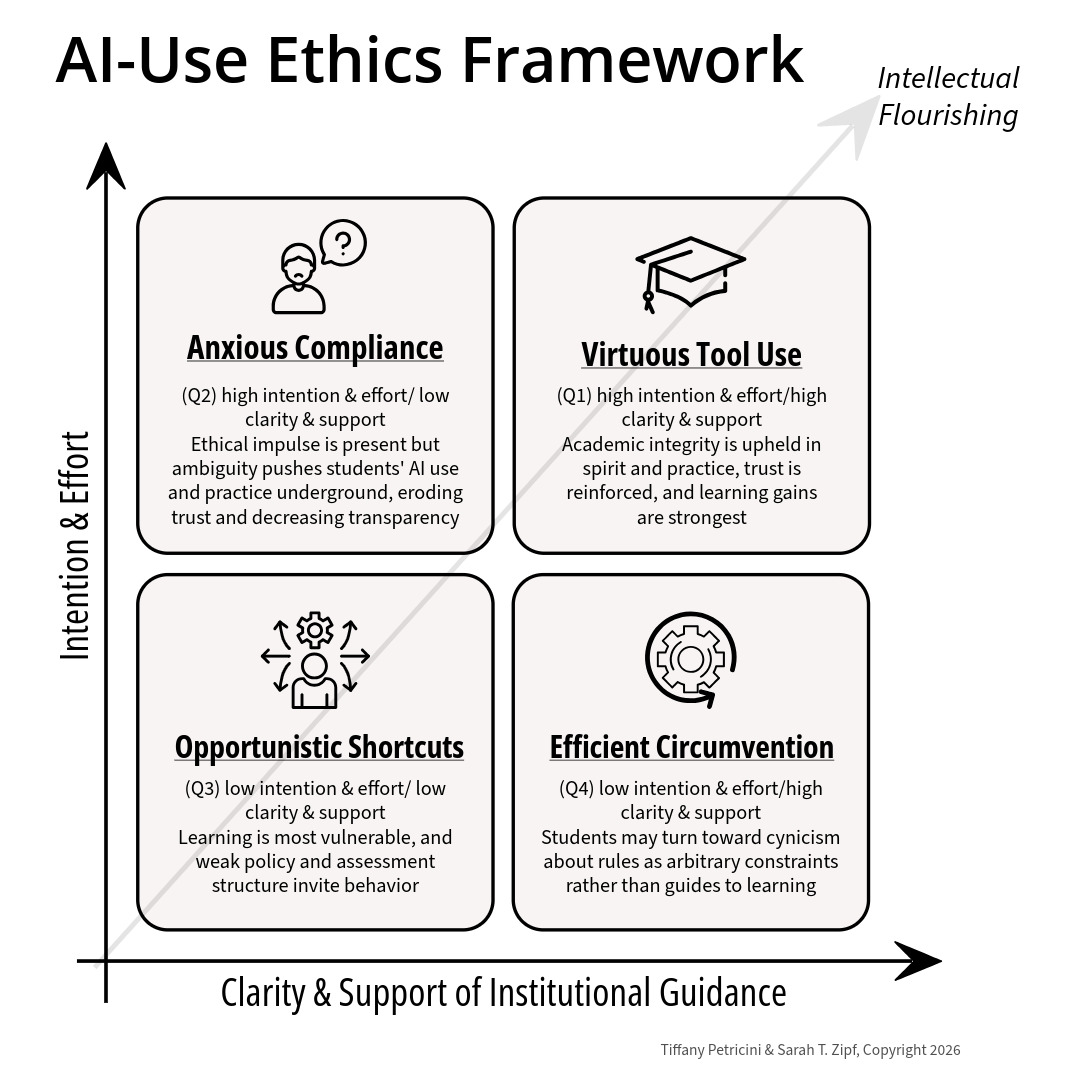
The AI-Use Ethics Matrix is derived from multiple studies and refined through dialogue with prior scholarship on academic integrity, AI ethics, and instructional design (Bearman et al., 2025; Bertram Gallant & Rettinger, 2025; Giray et al., 2026; Petricini et al., 2024, 2025; Petricini & Zipf, 2025; Wu et al., 2024; Wu & Carroll, 2025; Zipf et al., 2024, 2025, 2026). The matrix organizes AI use behaviors along two continuous dimensions identified inductively from prior research: the extent to which students bring intention and effort to their AI use, and the extent to which their institutional environment provides clarity and support (Figure 1). Much of the existing discourse surrounding AI use in education has focused on tools, policies, and outcomes, investigating what students use, what rules govern that use, and whether the resulting work is acceptable. However, these framings overlook a more fundamental question: under what conditions is ethical AI use actually possible?
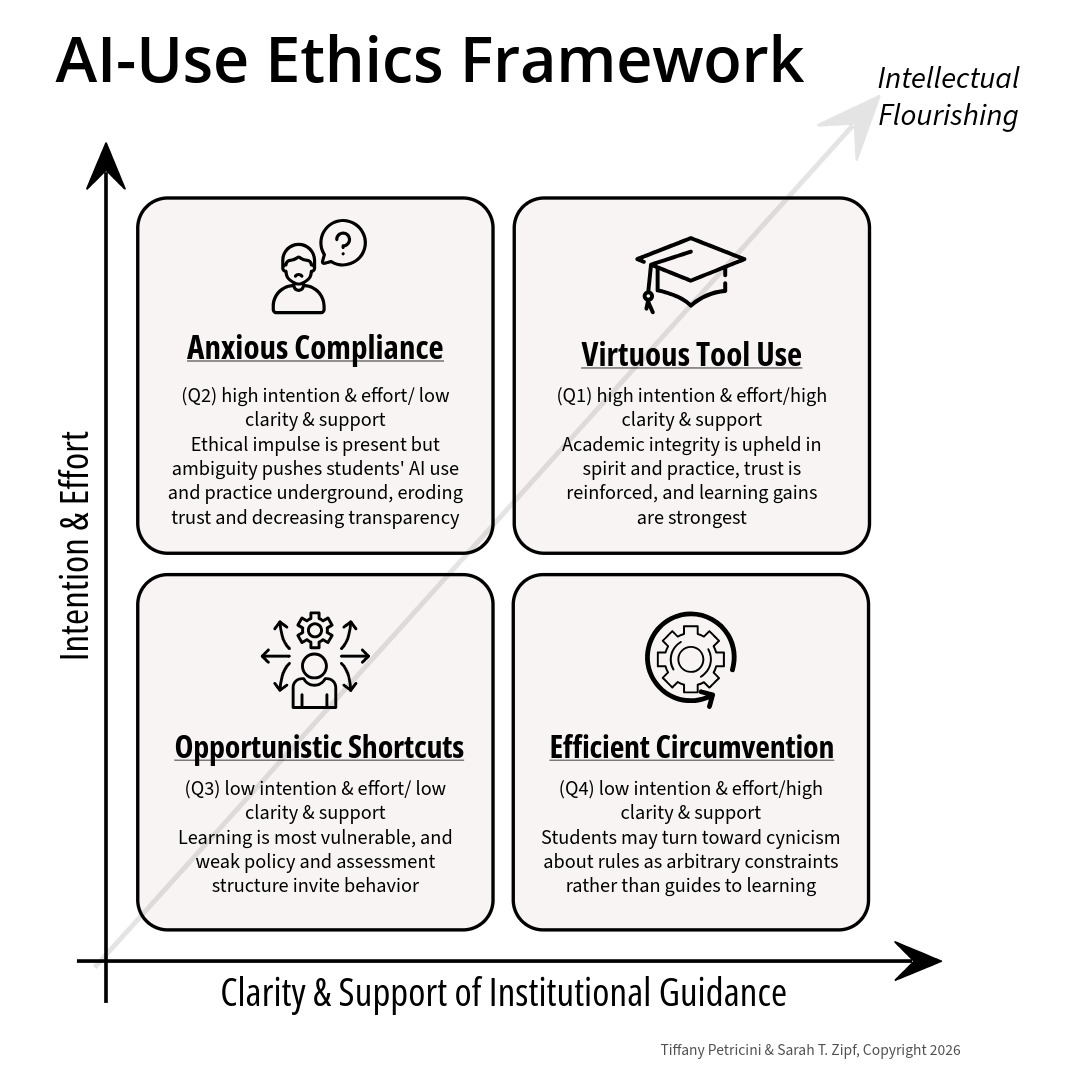
Across the empirical data, these two dimensions consistently emerged, not as variables, but as the conditions that structure how students use AI in practice. The first axis is the degree of student intention and effort directed toward learning. The second axis is the degree of clarity and support provided by the instructional environment. These dimensions function as internal and external conditions of ethical engagement. Intention without clarity produces uncertainty and risk; clarity without intention produces compliance and misses meaningful learning. Ethical AI use, therefore, cannot be reduced to either student disposition or institutional policy alone. Rather, ethical AI use emerges from the interaction between these two dimensions.
These two axes are defined neither by policy type, tool type, nor outcome quality. They are the operative variables in the ethics of AI use. The AI-Use Ethics Matrix formalizes the relationships between students and the curated learning environment. It does not categorize types of students or tools but rather models the conditions under which different forms of AI engagement become likely. In doing so, it moves from evaluating individual student behavior to understanding how student behavior is structured by the learning environment. It is worth noting that these axes do not claim to exhaust all variables relevant to AI use in classrooms. Factors such as course level, disciplinary culture, student prior knowledge, and institutional context also shape AI engagement. The matrix identifies the two dimensions that appeared most consistently across the empirical data; future research may elaborate or extend the framework as the evidence base grows.
The matrix produces four quadrants plotted empirically through 30 student interviews. The short, structured interviews took place at a large, research-intensive institution in the mid-Atlantic (Zipf et al., 2026). The data were coded using a process of lumping and open coding, and reveal four themes: intention and effort in students’ intellectual development; guilt, fairness, and emotional regulation of integrity and institutional responsibility of AI use; uncertainty, fear, and the need for standardized guidance; and, AI is shifting the role of human-centered contributions. These themes do not one-to-one onto the four quadrants. Rather, they informed the two matrix axes and helped interpret the behavioral and emotional patterns visible within each quadrant. Quotes included below are pulled from the larger dataset of the student interviews.
Axis 1: Intention and Effort
The first axis (Y) captures the degree to which a student’s goals and actions reflect genuine investment in learning, growth, and authentic skill development rather than mere outcome maximization. High intention and effort are evidenced through process artifacts (drafts, annotations, error analyses), metacognitive language that articulates reasons for tool use, time-on-task that positions AI as a resource deployed after initial independent effort, and integrated authorship that folds AI-assisted content into the student’s own reasoning. These indicators were consistently identified across student interviews as the moral criteria students themselves used to evaluate their AI use.
The AI-Use Ethics Matrix is a student-generated moral framework that centers on effort and intention as the functioning ethical variables; it replicates and extends prior findings on student reasoning about cheating (Waltzer & Dahl, 2023). The underlying concept aligns with Bertram Gallant and Rettinger (2025) in that academic integrity is most understood not as rule compliance but as alignment between learning, effort, and meaning. Motivation plays an important role in how students behave; predictably, disengaged students are more likely to use AI when they have no interest in their academic work (Playfoot et al., 2024). However, intention and effort cannot be based solely on student motivation; the direct connection between the stated learning objectives and the learning activities must be made clear. This axis of intention and effort is not fixed but rather is shaped by the conditions of the learning environment. Students who perceive their learning goals as meaningful and who see a connection between process and outcomes are more likely to invest intention and effort in their AI use. Students whose environments privilege product over process are more likely to use AI in ways that bypass rather than support understanding (Bertram Gallant & Rettinger, 2025; Petricini et al., 2024).
Axis 2: Clarity and Support of Institutional Guidance
Giray et al. (2026) state that the biggest issue with AI is the misunderstanding between students and faculty because of ambiguous or unclear policy messaging. Contemporary college students view AI the same as any other tool, comparing it to an online search engine (Zipf et al., 2026). While 31,000 syllabi show that from 2020 to 2025, AI statements have grown less restrictive and the disaggregation by academic discipline reveals more permissiveness in certain areas than others (Chirikov, 2026). The course-level decision of AI-use creates instances where students might have to navigate multiple policies at a time, contributing to confusion and uncertainty (Zipf et al., 2026).
This axis of clarity and support of institutional guidance refers to how course- and institution-level policies offer explicit, actionable, and consistent direction for the use of generative AI, while also providing necessary student support so that they may act on that guidance. High levels of clarity and support are evident when syllabi, assignments, and instructions clearly distinguish between permitted, discouraged, and prohibited uses of AI through concrete examples; when assessments are designed to accommodate transparent AI use through mechanisms such as process-based credit, staged drafting, or oral defenses; when students are given access to disclosure templates or instructional tutorials; and when policies are aligned across course sections and enforced in consistent, predictable ways. In contrast, low clarity and support emerge in contexts where policies are absent or ambiguous; where expectations vary or conflict across courses; where blanket prohibitions are imposed without clear pedagogical justification; and where enforcement relies on punitive detection practices rather than fostering dialogue and understanding. The student interviews are saturated with evidence of this dimension’s effects.
Students described navigating a “policy vacuum” (Zipf et al., 2026) in which almost no instructor had provided meaningful guidance about how AI related to their learning. Students often used implicit permission when explicit instructions were not provided. The uncertainty of this environment is not driven by the tools, but rather students have AI-use patterns showing a level of literacy and technical knowledge around AI tools prior to starting college (Freeman, 2025). The unclear and ambiguous institutional policies create anxiety, which increases by the lack of communication (Giray et al., 2026). The absence of clarity does not neutralize student AI use but instead displaces it. Students who lack institutional orientation often rely on their own ethical leanings in isolation, often under conditions of fear and self-censorship. This finding is consistent with the conclusion from Wu et al. (2024) that institutional AI policy is written from neither the student’s perspective nor their learning needs.
The Four Quadrants
The intersection of these two axes produces four empirically distinguishable quadrants, each with a distinct behavioral profile, emotional signature, and set of instructional implications.
Quadrant 1
Virtuous Tool Use (high intention/effort, high clarity/support). This quadrant is the target condition. Here, students encounter clear, enabling institutional guidance. AI is used transparently and as a tutor, an evaluator, a brainstorming partner, or as a feedback mechanism. Students revise AI output iteratively, disclose appropriately, and report confidence rather than fear. Academic integrity is upheld in both spirit and practice, reinforcing the trust between student and instructor, and learning gains are strongest. Empirically, this quadrant is populated by students who have received explicit guidance, who understand the pedagogical rationale for AI policies, and whose assignments reward process. For example, a student might use AI after drafting an initial response to generate alternative explanations, compare them against course concepts, and revise their work accordingly, documenting this process of AI-use as part of their submission.
Quadrant 2
Anxious Compliance (high intention/effort, low clarity/support). This quadrant captures students who are genuinely trying to learn but lack clear institutional orientation. They often hide otherwise legitimate AI uses such as grammar support, explanations of concepts, or idea organization after prior effort, to avoid the risk of false accusation. The emotional signature of this quadrant includes fear, guilt, and vigilance. This quadrant was the most populated quadrant in the present interview data, consistent with Bearman et al. (2025), where students described uncertainty, fear of misinterpretation, and cautious concealment of otherwise legitimate uses. Students in Anxious Compliance are not ethically indifferent but ethically burdened and the ambiguity pushes AI use underground. For instance, a student may use AI to clarify a concept or improve the organization of their ideas after completing initial work, but out of concern that these AI-use cases would be misinterpreted as misconduct remove any evidence of using AI.
Quadrant 3
Opportunistic Shortcuts (low intention/effort, low clarity/support). This quadrant appears where rules are absent and learning intention is low. Students rationalize direct substitution (“no rule said I couldn’t use AI”) and engage in minimal editing or answer harvesting, and is often normalized by peer behavior. Learning is most vulnerable in this quadrant. However, the qualitative data reveal that this pattern is far less common than institutional discourse suggests; students describing Q3 behaviors were frequently describing peers rather than themselves. For example, one student said:
So what I know is that a lot of students will use AI partially on the assignment. So they’re not going to entirely generate all of the writing for an assignment given like just from AI, but they will give AI an outline and then have the work requirement be filled by that. I don’t do that personally […] but I know the vast majority of students do something similar to that.."
These opportunistic shortcuts are not a product of student moral failure but rather a product of weak policy design and assessments that reward product over process, negatively impacting intention and effort. In this case, a student might input an assignment prompt directly into an AI tool and submit the output with minimal modification, justifying the decision on the absence of explicit guidance or enforcement.
Quadrant 4
Efficient Circumvention (low intention/effort, high clarity/support). This quadrant emerges when rules are explicit but assessment practices reward speed and product over demonstrated thinking. Students remain policy-aware but treat rules as hurdles to be gamed like laundering AI output, finding compliant workarounds that minimize cognitive investment. The emotional tone of this quadrant trends toward cynicism. Here, rules are experienced as arbitrary constraints rather than meaningful guides to learning. Raising institutional clarity without redesigning assessments risks shifting students from Q3 to Q4 and not towards virtuous use in Q1. For instructional designers, the implication is clear: guidance alone is insufficient if assessment structures continue to reward speed, polish, or output over demonstrated thinking. For example, a student may generate a full draft using AI, then strategically revise wording or structure to align with perceived policy expectations. In doing so, the student shifts their focus to avoiding detection rather than engaging with the underlying material and learning process.
Application–From Axis to Design: How Clarity Cultivates Agency
The AI-Use Ethics Matrix is a generative framework. Each quadrant implies a design intervention, and each axis points toward a distinct category of instructional action. This section develops three interlocking design principles derived from the matrix: (1) transparent AI design guidelines that reduce ambiguity along the institutional guidance axis; (2) assignments structured for intentional effort that shape movement along the student intention axis; and (3) classroom conditions that actively increase student agency. These principles are not sequential but are mutually reinforcing elements of a learning environment designed to make Virtuous Tool Use the natural and supported outcome, with the end goal being intellectual flourishing overall.
Principle 1: Make Institutional Guidance Explicit and Pedagogically Grounded
The most immediate instructional implication of the matrix is the need to move away from policy silence and toward purposeful, pedagogically grounded communication. Providing explicit guidance on AI use is not simply a matter of compliance; it is a relational act that signals to students that their learning is valued, that their questions have been anticipated, and that the instructor has thoughtfully considered how AI intersects with the goals of the course.
Transparent AI design guidelines should, at a minimum, clarify which uses of AI are permitted, encouraged, discouraged, or prohibited within the specific context of the course, explain how AI-assisted work should be disclosed, articulate the pedagogical rationale behind these distinctions, and demonstrate how AI use connects to course learning objectives as well as students’ broader skill development. This guidance should be integrated consistently across the course, appearing in syllabi, embedded within assignment descriptions, and reinforced through classroom discussion. Transparency in practice is not as a one-time policy statement, but is an ongoing orientation that evolves alongside students’ learning. While it may begin with a simple AI expectations table in the syllabus, assignment-specific examples and brief in-class discussion of why certain uses are encouraged or restricted should be restated and reiterated.
Borenstein and Howard (2021) argue that ethical reasoning about AI cannot be reduced to rule compliance but must be cultivated as an educational process. These transparent design guidelines are the instructional infrastructure through which this cultivation begins. Consistent policy across sections is itself an equity issue. Zipf et al. (2025) demonstrate that inconsistent AI policies across courses create information inequities, exposing some students to higher false-accusation risk and leaving others without the guidance needed to develop ethical AI practices.
Principle 2: Design Assignments for Intentional Effort
The second design principle addresses the intention and effort axis directly. Assignments should be designed to make process visible, valuable, and rewardable. Our empirical record consistently shows that students distinguish ethical from unethical AI use based on whether it supports or substitutes their own thinking. Their distinction tracks with whether assignment designs reward product or process. When assignments are structured so that the final deliverable is the only thing that counts, students face a structural incentive to optimize the output. When assignments make the process of thinking legible and gradable, students face a structural incentive to engage with the learning process.
Specific strategies that guard against Q4 dynamics include oral defense requirements (brief presentations in which students explain and extend their submitted work), iterative submission structures (in which drafts and revision notes are collected alongside final products), and AI-use justification prompts that ask students to articulate the reasoning behind their tool choices — none of which prohibit AI, but all of which make circumvention visible and cognitively costly. Implementation constraints matter. Instructors working with large enrollments, limited grading time, rigid curricular requirements, or uneven institutional support may need lighter-touch adaptations. Even small changes—such as requiring one reflective checkpoint or adding a short disclosure prompt—can improve alignment without major course redesign.
Concrete assignment design strategies aligned with the matrix include process-based assessment structures that award credit for drafts, outlines, or revision histories. Another recommendation is an AI-use disclosure log that requires students to document when, how, and why they used AI in relation to their own thinking. Designers might also recommend comparison tasks in which students contrast AI-generated and human-generated responses and analyze the differences. Some professors might turn to oral defenses or micro-presentations in which students explain and extend their written work. These design strategies do not require instructors to prohibit AI but instead to require that AI use be transparent, purposeful, and integrated with demonstrated understanding.
One particularly significant design insight from the matrix is the warning against raising clarity without redesigning assessments. Increasing institutional guidance while maintaining product-focused, high-stakes assessment structures does not move students into Q1. It risks moving them into Q4. Students who understand the rules but whose assessments reward speed and polish over process may become more sophisticated at evading detection rather than more invested in learning. Ethical AI integration requires both axes to be addressed and transparent guidance and process-centered assessment must be developed in tandem.
Principle 3: Cultivate Student Agency Through Choice, Transparency, Accountability, and Reflection
The third principle addresses the deepest layer of the matrix’s implications. Just as important as process and policy is the greater overarching design of the environments in which these are embedded. Learning environments can be designed to actively cultivate students’ capacity for ethical judgment. Student agency, or the ability to make meaningful, informed, self-directed choices (Stenalt & Lassesen, 2022), about how to engage with AI in service of one’s own learning does not develop automatically. It is cultivated through structured opportunity. When instructors frame AI as a threat, an assistant, or a transformative partner, it can shape the conditions under which students either develop or defer their own ethical reasoning. This connection between instructor framing and student agency is a promising design hypothesis that warrants further applied research and practice.
Choice is a foundational element of cultivating agency. When students have meaningful options about how and whether to use AI in completing an assignment, coupled with reflection on the tradeoffs, they practice the kind of deliberate, reasoned engagement that characterizes Virtuous Tool Use. Transparency of use can work alongside student choice. Instructors and instructional designers can create new classroom norms so students can openly discuss their AI use, which includes their uncertainty and their mistakes, and thus reduces the psychological cost of ethical behavior and builds the relational trust (Bearman et al., 2025). Accountability structures, such as AI-use justification memos or peer review of AI-assisted reasoning, make students’ ethical agency visible and assessable without reducing it to surveillance. Reflection, integrated across the arc of an assignment or course, allows students to develop metacognitive awareness of their AI use and articulate the relationship between tool use and their own intellectual growth.
Beyond Resilience: Designing Ethical Learning Environments
The framework developed in this article is not ultimately about assignment design alone. It is about learning environments and the ecological conditions in which students can form their habits of thinking and orientations toward their work and develop an understanding of what integrity means and why it matters. The implications of the matrix extend beyond the individual assignment or course policy, with three environmental imperatives emerging from the framework. First, ethical expectations must be made visible, not as prohibitions to be enforced, but as orientations to be taught. This concept then becomes a pedagogy of orientation, not compliance. Second, environments must be designed to reduce the fear of false accusation. The emotional burden carried by students in Q2 (anxious compliance) is not a side effect of institutional AI policy but rather a direct result of surveillance-based responses that criminalize ambiguity. Moving away from detection tools and toward disclosure-based frameworks, as the matrix recommends, is not only a pedagogical choice but a justice-informed one.
Finally, surveillance must be replaced with structure. Central to more ethical AI use is knowing that the work detection tools and prohibition policies attempt to do through monitoring can be done more effectively and ethically through instructional design. Structured scaffolding, transparent expectations, and process-centered assessments do not merely constrain unethical behavior but rather they create the conditions under which ethical behavior becomes the natural, supported, and rewarded choice. Borenstein and Howard (2021) describe this as the shift from AI ethics as rule enforcement to AI ethics as educational formation. The matrix operationalizes this educational formation shift for instructors and instructional designers.
Conclusion
The central challenge of AI-mediated classrooms is not simply misconduct; it is the design of environments in which students must make ethical decisions under uneven conditions of clarity, trust, and support. When educators redesign courses around transparency, process, and agency, they move beyond surveillance and prohibition toward learning-centered integrity. The AI-Use Ethics Matrix offers a practical framework for thinking holistically about the student experience as a design challenge by shifting attention from assumptions of intentional cheating toward clarity, guidance, and ethical learning design. The matrix can help uncover areas where the fragile conditions under which learning, trust, and integrity had been sustained can be remedied through student-centered learning design.