Agentic AI Has Exposed a Flaw in How We Design Assignments Faculty across disciplines have begun noticing that students can now submit work meeting every rubric criterion with no evidence of the thinking that learning requires. The products look right. The process is absent. This concern sharpened when agentic AI tools became accessible to students. Agents built on Anthropic Claude, OpenAI Codex, and browser-integrated systems like Perplexity Comet do not just answer questions; they autonomously navigate course platforms, complete multi-step workflows, and submit finished work (Palmer, 2026). In educational contexts, this means that the unit of concern is no longer the paragraph or essay, but the assignment workflow itself. In a recent demonstration, researchers showed that ChatGPT could complete a semester-long engineering course under a minimal-effort usage protocol and earn a passing grade (Puthumanaillam et al., 2025). Such capabilities are commercially available and actively used by students, prompting calls from professional organizations for legislative and platform-level responses (Modern Language Association, 2025).
The instinctive institutional response has been to petition AI companies to restrict their products’ capabilities in educational contexts. This response misunderstands the technical and commercial dynamics of the AI industry. The scaling literature documents a sustained movement toward larger and more capable models, with performance improving predictably as model size, data, and compute increase (Bender et al., 2021; Kaplan et al., 2020). In that context, companies competing for users and market share have strong incentives to expand capability rather than constrain it. There is no reliable structural mechanism by which educator requests translate into product redesign. Agentic systems can inspect files, follow instructions across multiple steps, revise outputs, run checks, interact with browser-based environments, and produce polished deliverables with minimal human intervention. In educational contexts, this means that the unit of concern is no longer the paragraph or essay, but the assignment workflow itself. Detection tools offer a parallel path, but they assess the product rather than the process: they can generate false positives, particularly for some groups of writers, and false negatives when AI-generated text is paraphrased or otherwise modified to evade detection (Elkhatat et al., 2023; Liang et al., 2023; Perkins et al., 2024; Scarfe et al., 2024). The more durable response is to redesign what we ask students to do.
AI task completion exposes a fundamental misalignment between course design and the learning outcomes it claims to assess. Assessment scholars have long argued that final-product evaluation conflates task completion with genuine understanding (Boud & Falchikov, 2006; Sadler, 1989). AI agents have made that conflation impossible to ignore. This paper attempts to address the problem at all three levels where it lives: course design (what we ask students to do across a curriculum), assignment design (how individual tasks are structured), and assessment design (what evidence of thinking we collect and grade). These levels are treated as distinct in the literature but must be addressed together if any single intervention is to hold.
What Breaks When AI Agents Enter Assignments
Three categories of assignment break down most visibly in AI-saturated environments.
-
Assignments built around information retrieval. Any task that asks students to find, reflect, summarize, synthesize, or report information can be completed in full by an AI agent. This includes traditional research papers, reading responses, discussion posts, and most online quizzes. The student’s only cognitive contribution becomes deciding which prompt to type.
-
Assignments graded on polish rather than reasoning. When rubrics reward grammatical correctness, structural completeness, and citation formatting, AI excels. These criteria were always imperfect proxies for learning—a finding well-established in the assessment literature before AI entered the picture (Boud & Falchikov, 2006; Sadler, 1989). AI agents have simply made that imperfection undeniable.
-
Assignments without decision history. Any task that evaluates only a final product has no mechanism to distinguish a student who reasoned their way to an answer from one who accepted an AI response unchanged. Research on learning processes confirms that identical products can emerge from wholly different reasoning pathways, and that the pathway (not the product) is where durable learning occurs (Chi et al., 1989; Ericsson et al., 1993). The products may be identical, while learning is not.
The result is a false signal problem: high-quality output no longer reliably indicates genuine understanding. Bearman et al. (2024) emphasize this point: generative AI has widened the gap between students’ capacity to produce work and their capacity to evaluate its quality, making evaluative judgment the critical competency assessment must now develop. This is not an argument against AI use. Research shows that unguided AI use is associated with increased cognitive offloading and reduced critical thinking performance, but that structured prompting preserves and improves reasoning compared to unassisted AI interaction (Gerlich, 2025a, 2025b). The difference is whether the design of the task requires them to remain cognitively engaged. That is an assignment design problem, and it is what this paper aims to address.
Recent scale development work reinforces this concern: Dizon et al. (2026) developed and validated the Metacognitive Laziness Scale, demonstrating that students’ tendency to offload metacognitive processes (goal-setting, error monitoring, and strategic reflection) to AI tools is empirically distinct from general work avoidance and is significantly associated with academic disaffection rather than engagement. This finding underscores that the problem is not AI use per se, but the structural absence of requirements for students to exercise metacognitive effort.
AI Agents Have Specific, Exploitable Weaknesses
The most useful reframe for instructors is this: AI agents are exceptionally good at generating answers, but they are genuinely bad at sustaining a coherent history of thought. Designing around that gap is not a workaround. It is a pedagogically sound strategy grounded in how current language models actually work (Bender et al., 2021; Zaphir et al., 2024).
Agents built on large language models, including those from Anthropic and OpenAI, often struggle in the following areas:
-
No lived memory. Without explicit memory, records, or instructor-provided context, agents often struggle to track thinking across time or linked assignments. They generally do not know what a student argued last week, what happened in class Tuesday, or what constraints the student committed to earlier in the same assignment.
-
Confident ignorance. Agents can generate confident, well-formatted responses even when they are wrong. They may fail to say ‘I don’t know’ or to flag uncertainty clearly. When interacting with a flawed tool or a poorly framed question, they often accept and amplify errors without adequate qualification (Zaphir et al., 2024).
-
Inconsistency across linked responses. Ask an AI to defend a position it took in a previous response, and it may contradict itself. It can also be nudged into a different answer and has no genuine stake in the position and no lived position history. It may hedge or reverse without acknowledging that it has done so (Dutta et al., 2026).
-
Difficulty holding positions under pressure. When challenged with adversarial follow-up questions, AI agents often capitulate or hedge. A human who has genuinely reasoned to a position can hold it under pressure and either defend or revise it with explanation (Zaphir et al., 2024).
-
No local or tacit knowledge. AI agents generally have no access to what happened in a specific classroom, on a specific campus, in a specific patient population, or in a dataset built during a particular lab session unless that context is supplied. They cannot fake presence reliably.
-
Lack of reproducibility. AI can produce plausible-sounding reflective text. But it cannot reliably reconstruct a genuine decision history. When reflective prompts are specific and tied to earlier documented decisions, AI-generated metacognition often collapses under close reading (Austin, 2026b).
These are recurring structural vulnerabilities in current language-model-based systems. Assignments that require sustained reasoning across connected responses, honest acknowledgment of uncertainty, position-holding, and engagement with course-specific context exploit these limitations directly.
A Practical Framework for AI-Resilient Assignment Design
Theoretical Grounding
The approach described in this paper is grounded in three complementary frameworks.
The first is the UnBlooms™ Framework (Austin, 2025), a problem-centered alternative to Bloom’s Taxonomy that asks what is the problem we are trying to solve? It then foregrounds metacognition, contextual judgment, and human agency in AI-augmented learning. Rather than treating creation as a hierarchical endpoint, UnBlooms™ positions AI-generated output as raw material requiring evaluation, verification, and refinement—a structure that aligns with Understanding by Design’s foundational principle of beginning with the desired outcome and working backward to design assessments and learning experiences that make that outcome visible (Wiggins & McTighe, 2005).
The second is the Gradual Release of Responsibility model (Pearson & Gallagher, 1983), which describes how learners progressively assume greater cognitive ownership as scaffolding is deliberately withdrawn. In AI-mediated contexts, this progression is inverted and intensified: as AI assumes generative functions, learners must assume greater evaluative and metacognitive responsibility.
For practitioners considering institutional adoption, Rogers’ (2003) Diffusion of Innovations framework offers useful guidance. New instructional practices spread most reliably when they are perceived as having relative advantage over existing approaches, are compatible with existing workflows, and are low enough in complexity to trial without full commitment.
The Multi-Stage AI Interaction Protocol is designed with all three criteria in mind.
The Question–Generate–Critique–Refine Loop
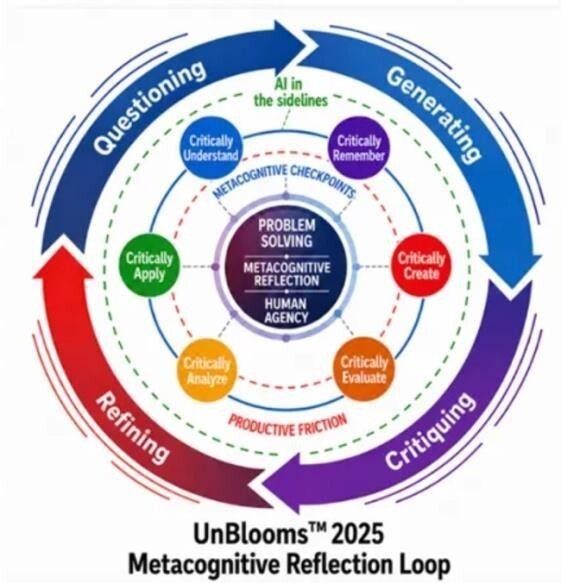
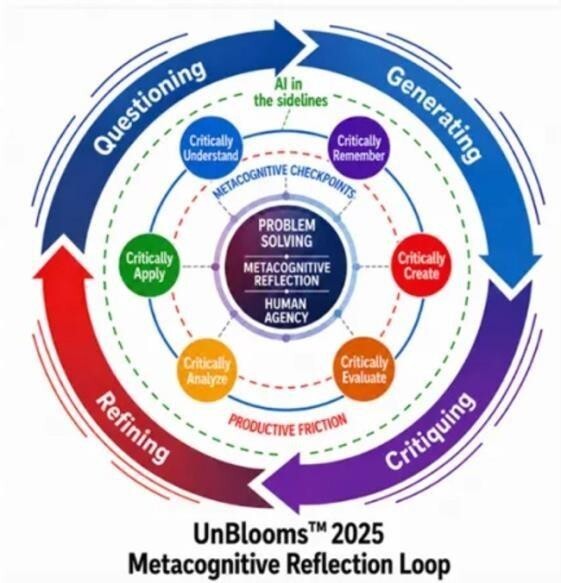
The UnBlooms™ Framework structures AI interaction through four recursive movements: questioning, generating, critiquing, and refining. The purpose of the loop is to make student reasoning visible before, during, and after AI use (Austin, 2025). Students first define what they need to know and what assumptions shape the task. They then generate an initial response, either independently or with AI assistance. Next, they critique the response for accuracy, gaps, assumptions, and oversimplifications. Finally, they refine their work based on that critique. The loop is recursive rather than linear: students may return to questioning, generate again, or deepen their critique as their understanding changes. Metacognitive reflection anchors each stage, producing the reasoning trail that instructors can assess.
Scaffolding the Framework
A recurring implementation challenge is that students arrive without the evaluative vocabulary or habits of mind the framework assumes. The Gradual Release of Responsibility model (Pearson & Gallagher, 1983) offers the right scaffold: introduce the framework in stages, modeling each move explicitly before requiring students to perform it independently.
A practical sequence for a semester-length course: in weeks one and two, the instructor models the Question step publicly, narrating aloud what they actually need to know before consulting AI. In weeks three and four, the class critiques AI output together. In weeks five and six, students perform the Question and Critique steps with a partner. From week seven onward, students complete the full loop independently, with the instructor grading the reasoning trail rather than the final product.
A Five-Level Scale for Assessing AI-Mediated Thinking
Not all AI engagement looks the same. The following scale, adapted from the UnBlooms™ Metacognitive Awareness Scale checkpoints (Austin, 2026a), operationalizes evaluative judgment as defined by Bearman et al. (2024): the capacity to assess quality in AIgenerated and human-generated work alike.
-
Level 1 – Critically Recognize: The student can identify that human reasoning and AI processing approach problems differently and articulate at least one concrete difference in their own words.
-
Level 2 – Critically Identify: The student can locate specific errors, gaps, or oversimplifications in AI output and explain what is wrong and why.
-
Level 3 – Critically Analyze: The student can identify the assumptions and frameworks embedded in AI output, what perspectives are present, what is missing, and what the training data likely foregrounded or suppressed.
-
Level 4 – Critically Evaluate: The student can assess the broader implications of AIgenerated knowledge: whose sources are included or flattened, what systemic effects might follow, and what disciplinary expertise the AI lacks.
-
Level 5 – Create / Resist: The student designs something new—a verification protocol, a revised workflow, or a method that transcends what AI alone can produce—OR deliberately chooses to work without AI because the cognitive struggle is itself the learning goal (Austin, 2026a). Both outcomes require the same depth of metacognitive awareness and disciplinary judgment.
Operationalizing the Scale: An Illustrative Rubric
The scale above requires translation into gradable criteria before it can function as an assessment instrument. Table 3 illustrates how each level maps to observable evidence and point values.
This cumulative structure is what makes the UnBlooms™ metacognitive awareness scale a taxonomy rather than just a list. It also maps reasonably well onto Facione’s (1990) canonical critical thinking dispositions (interpretation, analysis, evaluation, inference, explanation, selfregulation), which gives it theoretical grounding in the pre-AI literature (Facione, 1990).
Practical Assignment Strategies
The Multi-Stage AI Interaction Protocol
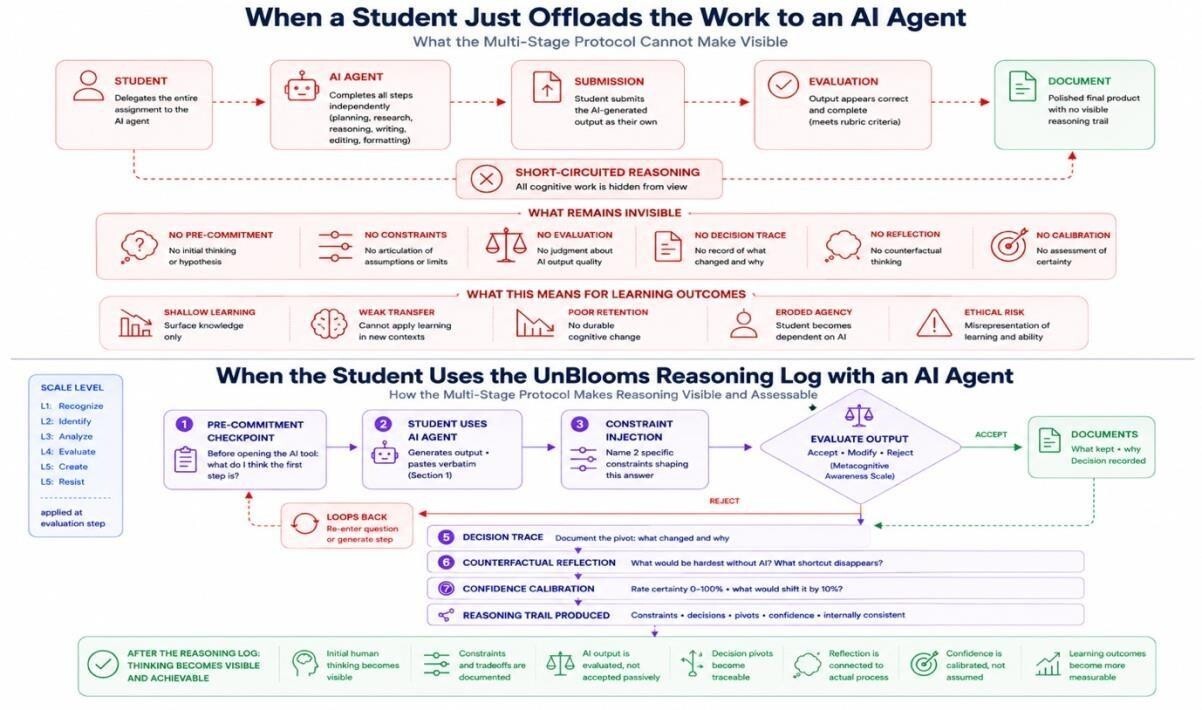
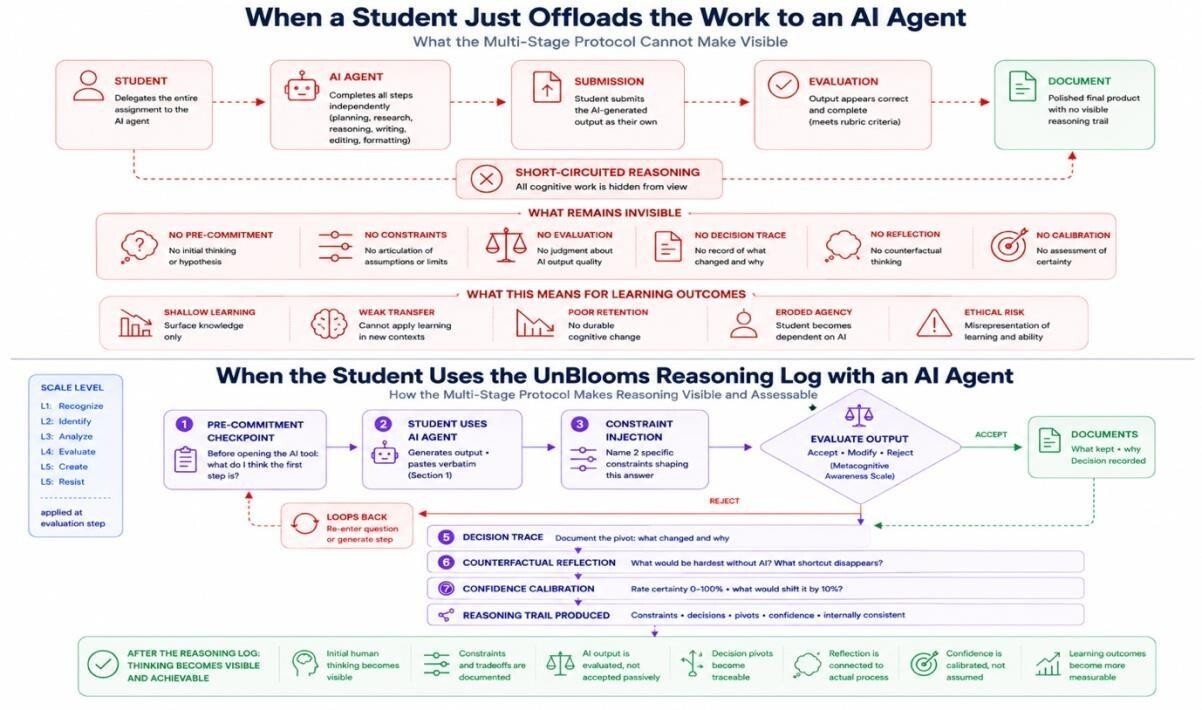
The following structure can be adapted for any course in any discipline (see Figure 2). It deliberately sequences tasks to exploit AI’s structural weaknesses while centering student reasoning.
Applying Table 1 in Synchronous and Asynchronous Courses
In both synchronous and asynchronous courses, instructors can use Table 1 as a design map rather than a warning list. The practical move is to lean into the inherent AI issue most relevant to the task and build the assignment so that the AI’s predictable weakness becomes the student’s learning opportunity. In an asynchronous history course, for example, an instructor who knows that AI may reproduce biased or reductive historical narratives can require students to identify how an AI-generated account frames causality, whose perspective it omits, and how that framing compares with a specific primary source or class reading. In a synchronous discussion, the same move can happen live: students can challenge the AI’s framing together, revise the account, and explain what evidence forced the revision.
The same principle applies in scientific, technical, and image-based work. If an AI system cannot reliably interpret an electron microscope image, a lab diagram, or a locally generated dataset in the way a trained student can, the assignment should require students to mark what they see, explain the evidence for their interpretation, and compare that interpretation with the AI’s output. If an AI can be nudged into a wrong answer, students can be asked to test how easily the answer changes under pressure and then document which version is defensible. If sticky memory causes the system to conflate two readings, two cases, or two datasets, the task can require students to catch the conflation and explain why the sources must remain distinct. If the system does not reproduce the same answer each time, students can run multiple generations and analyze the variation rather than treating a single response as authoritative.
For asynchronous classes, these moves can be implemented through timestamped checkpoints, staged LMS submissions, AI-output comparison logs, and discussion posts that require students to refer back to their earlier documented decisions. For synchronous classes, they can be implemented through live prompting, paired critique, short in-class defense of a position, or rapid comparison of multiple AI responses. The modality changes the evidence collection method, but the design principle remains the same: the assignment should make students work with the AI’s limitations instead of allowing those limitations to remain invisible.
-
Section 1 – Baseline (AI-permitted, transparency required): Students use any available resource, including AI, to generate an initial response and paste the AI output verbatim. This removes the incentive to hide AI use and establishes a shared reference point. This section is graded lightly. Transparency is what matters here.
-
Section 2 – Constraint Injection (where AI begins to struggle): Students list two specific constraints that shaped their thinking before finalizing their response—such as audience assumptions, ethical risks, data limitations, or edge cases. The constraints must be specific to their answer, not generic. AI agents default to generic constraints because they have no knowledge of why this particular student cared about these particular constraints.
Generic responses score poorly by design. Note: students should receive explicit instruction in constraint identification before this section is graded (see Scaffolding, above).
-
Section 3 – Decision Trace (the core of the assessment): Students describe one moment when they changed their approach after seeing an AI suggestion. What did they keep? What did they reject, and why? This requires judgment, not knowledge. AI cannot reconstruct a student’s genuine decision pivot. Responses are graded on coherence, plausibility, and alignment with the constraints listed in Section 2, not on correctness.
-
Section 4 – Counterfactual Reflection (highly AI-resistant): Students answer: ‘If you had to complete this task without AI, what part would be hardest, and what shortcut would no longer be available?’ An AI agent can generate a plausible answer here, but it will not align with the specific constraints the student listed, the revisions they described, or the choices they documented earlier. That misalignment is visible when responses are read together.
-
Section 5 – Confidence Calibration: Students rate their confidence in their final answer (0 to 100 percent) and explain what would raise it by 10 percent. AI agents tend to produce polished, overconfident responses here, which is itself a diagnostic signal. This section surfaces students’ epistemic awareness and reframes the exercise around genuine learning rather than compliance.
An Example: The Biology Lab Report
Consider a standard undergraduate biology assignment: a lab report on enzyme kinetics. In its traditional form, a student submits a formatted report with introduction, methods, results, and discussion. An AI agent can produce a competent version of all four sections in under two minutes.
Redesigned using the Multi-Stage Protocol, the assignment looks like this. Before opening any AI tool, the student writes one paragraph predicting what their Michaelis-Menten curve will show based on the specific substrate concentration they used in lab—a constraint the AI cannot know. This is Section 1: baseline reasoning from lived experience.
In Section 2, the student names two constraints shaping their interpretation: the temperature fluctuation they observed during the experiment, and the fact that their substrate was slightly degraded. These are specific, local, and non-generalizable. An AI agent given the same prompt will produce generic constraints about enzyme kinetics broadly.
In Section 3, the student describes the moment they rejected the AI’s suggested explanation for their anomalous data point—because the AI didn’t know that their pipette was miscalibrated in trial three. That decision pivot, grounded in tacit lab knowledge, cannot be fabricated by a system with no presence in the room.
The result is a report that looks similar to the traditional version on the surface. But the reasoning trail underneath is entirely the student’s own—and it is the trail that gets graded. A student who outsourced the thinking cannot reconstruct it under questioning. A student who did the thinking can explain every decision.
Productive vs. unproductive paradigms. This example also illustrates where the UnBlooms™ Discernment Rate (UDR) becomes useful as a classroom-level signal (Austin, 2026a). The Discernment Rate—the proportion of AI outputs a learner interrogates, challenges, or revises rather than accepting at face value—can be tracked across assignments over a semester. An instructor who notices that a student’s Discernment Rate is near zero across five consecutive assignments has a signal worth investigating: not that the student is cheating, but that the assignments may not be demanding enough human reasoning to make interrogation feel necessary. Paired with First-Pass Acceptance Rate (how often a student uses AI output without any modification), these behavioral proxies give instructors a practical lens for evaluating whether their task design is doing what they intend. The biology example above, by design, produces a high UDR because students who engage genuinely with Section 3 must by definition have challenged at least one AI output.
Sample Assignment Redesigns
Redesign 1: STEM Problem-Solving
A traditional problem set becomes a four-part assessment. Part A asks students to use AI to explain a core concept and paste the response verbatim, then identify one strength and one oversimplification. Part B asks students to solve a closely related problem without AI and document their reasoning steps. Part C asks them to compare their approach with the AI’s: where did the reasoning paths diverge, and which was more accurate? Part D asks: ‘What disciplinary knowledge would you need in order to identify the AI’s error independently, without prior engagement with the problem?’
Redesign 2: Argumentative Essay
Before writing, students list the three strongest counterarguments to the position they plan to defend and state their thesis in one sentence. They then prompt AI to generate a counterargument and paste the output. In the essay, students must address the AI-generated counterargument directly—accepting, refuting, or revising it—and explain in their conclusion what the AI missed about the complexity of the question that their engagement with course material revealed.
Redesign 3: Project-Based Work
Students submit a two-stage deliverable. Stage 1 is a documented decision log: a record of the three approaches considered, why they chose one, and what they rejected, completed before any AI assistance. Stage 2 uses AI to stress-test the chosen approach. Students document what the AI identified as weaknesses, which they agreed with and why, and what the AI missed because it lacked knowledge of their specific context or course material. Most learning management systems, including Canvas and Blackboard, support the kind of iterative submission and timestamped documentation that the decision log requires.
What Changes in Student Behavior
When this structure is applied consistently across multiple assignments, several behavioral shifts become observable. Students begin distinguishing between using AI to think and using AI instead of thinking. This distinction, invisible in traditional assignments, becomes explicit when students are required to document their decision history.
Many report that the pre-commitment step (committing to an idea or set of constraints before consulting AI) changes their relationship to the tool. They begin to notice when they are reaching for AI out of habit rather than need. This observation aligns with research on the IKEA Effect (Norton et al., 2012), which demonstrates that people value outcomes more when they have invested effort in producing them.
Students also develop more accurate calibration about their own uncertainty. The confidence calibration step surfaces a pattern otherwise hidden: many students do not know what they do not know, and AI’s fluent confidence reinforces that illusion.
A subtler shift emerges over time: students develop an internal critic, a habit of pausing before accepting a plausible-sounding output. This is not a side effect. It is the goal.
What Did Not Work
- Reflection prompts placed after the final product. When students reflect on their AI use after submitting finished work, the reflection tends to be retrospective and superficial.
The fix is sequencing: pre-commitment must precede AI interaction, not follow it.
-
Generic metacognitive logs. Students given unstructured prompts produce vague statements. Some students use AI to generate their metacognitive logs, producing fluent reflective text entirely disconnected from their actual process. The solution is specificity: prompts that require particular, traceable details are much harder to fabricate convincingly.
-
Detection software as a substitute for redesign. AI detection tools assess the product, not the process. They produce false positives for students who write clearly and false negatives for students who know how to vary AI output style (Perkins et al., 2024). Using them as a substitute for assignment redesign solves the wrong problem.
-
One-time redesign without structural follow-through. Adding a reflection prompt to an otherwise unchanged assignment produces compliance without transformation. The multi-stage structure works because it builds a practice over time.
Implications for Practice
Start with one assignment, not a whole course. Identify one high-stakes assignment where AI use is currently invisible and unmanaged. Apply the constraint injection and decision trace steps. Read the responses against each other for internal consistency.
Revise the rubric before revising the assignment. Add one criterion that assesses the specificity and coherence of a student’s documented decision-making. Grade it seriously.
Students adjust to what is actually weighted.
Build tasks around inherent AI flaws. Any assignment grounded in what happened in a specific classroom, in a specific dataset, or in the specific debate students had on a specific day is already AI-resistant.
Design for the reasoning trail. The student who thought their way to an answer and the student who outsourced the thinking produce the same product. They do not produce the same reasoning trail. When the trail is what gets assessed, thinking becomes the only path to a passing grade.
Quick Start for Practitioners
For instructors who want to implement these strategies immediately, the following sequence requires no course redesign and can be applied to the next assignment you assign.
-
Add a pre-AI commitment step. Before students consult any AI tool, require them to write their initial position, thesis, hypothesis, or a list of two constraints in their own words.
-
Insert a decision trace question. Ask students to describe one moment they changed or rejected an AI suggestion and explain why. Grade this response for specificity and coherence, not correctness.
-
Add constraint injection. Require students to name two specific constraints that shaped their final answer. Make clear that generic responses will score low.
-
Grade reasoning explicitly. Add one rubric criterion worth meaningful points:
‘Documents specific decisions, revisions, and reasoning.’ When this criterion is weighted, students produce the reasoning trail.
-
Read responses together, not in isolation. Internal consistency across sections is the most reliable signal of genuine work.
Conclusion
The arrival of agentic AI in educational settings has not created a new problem. It has run a diagnostic on a problem that was already there: most assignments were measuring task completion, not thinking. The diagnostic result is uncomfortable but clarifying. If an AI agent can complete a course end-to-end, the course was not assessing what we believed it was assessing.
The response this paper recommends is less technological and more pedagogical. By redesigning assignments to make the reasoning trail (not the final product) the unit of discernment, instructors can exploit the structural limitations of current AI systems while building exactly the capacities that professional and civic life will require of students: the ability to evaluate sources of information, hold positions under pressure, identify what they do not know, and make contextually grounded judgments.
The Multi-Stage AI Interaction Protocol, the Question–Generate–Critique–Refine loop, and the five-level Metacognitive Awareness Scale are not AI-proofing strategies. They are assessment design strategies that happen to be AI-resilient as a consequence of being educationally sound. Assessments that require visible reasoning have always been harder to game than assessments that reward polished products. AI agents have simply raised the stakes.
What remains unresolved is a question of scale. The framework described here has been developed and applied within individual courses and instructor contexts. Cross-institutional validation, formal inter-rater reliability studies, and longitudinal outcome data are needed to establish how reliably the Metacognitive Awareness Scale captures genuine growth in epistemic judgment across disciplines and student populations. That work is underway. In the meantime, the practitioner-facing tools in this paper are designed to be immediately usable, iteratively refinable, and honest about what they do not yet prove.
Thinking about your own thinking is still the hardest thing to fake. The goal of assignment design in the age of AI should be to keep it that way.
Generative AI Disclosure
Generative AI tools were used in the preparation of this manuscript for developmental editing and prose refinement. All conceptual content, framework design, instructional examples, and analytical conclusions reflect the author’s original work. No AI-generated text appears in this manuscript without substantial human revision.