Higher education institutions are increasingly challenged to design learning experiences that connect global sustainability goals to students’ lived realities. In Philippine college courses such as Science, Technology, and Society (STS), abstract discussions of sustainable development can remain theoretical unless supported by contextualized, participatory instructional strategies. Integrating digital tools into project-based learning offers opportunities to bridge this gap by enabling students to visualize and construct meaning through creative, collaborative processes (Dooly, 2026; Huang et al., 2026; Pae et al., 2026).
This article describes the implementation of a digital collage project as an instructional design strategy to engage college students through visual storytelling. The project was conducted in an undergraduate STS course at a local higher education institution in Cagayan de Oro City, Southern Philippines. The instructional goal was to help students explore themes related to Sustainable Development Goal 11 (SDG 11: Sustainable Cities and Communities), which aims to make cities and human settlements inclusive, safe, resilient, and sustainable. By grounding global sustainability concepts in their own community context, students examined local environmental and urban challenges while envisioning community-based solutions. Using Canva as a collaborative digital design platform, students worked in small groups to create visual collages that represented environmental challenges and proposed community-based solutions. The project was structured as a technology-enhanced, project-based learning activity that combined multimodal design, group collaboration, and reflective discussion, and was implemented over a two-week period within the semester of School Year 2025-2026. It was implemented to include conceptual orientation, collaborative design, presentation, and reflective synthesis. Rather than relying solely on traditional written outputs, students were encouraged to communicate ideas through images, layout, symbols, and brief textual anchors, thereby promoting visual literacy and critical engagement (Xue, 2026; Zaky, 2026). This article outlines the evidence-based rationale for using digital collage in instruction, describes the project implementation process, and presents outcomes related to student engagement, sustainability awareness, and instructional effectiveness. By articulating this implementation as an instructional design model, the article provides educators with a practical and transferable framework for integrating digital visual storytelling into sustainability-focused coursework.
Literature Review
Instructional design in higher education increasingly emphasizes active learning strategies that promote student engagement, critical thinking, and real-world application. Project based learning (PBL) is widely recognized as an effective approach that shifts students from passive recipients of information to active constructors of knowledge (Dooly, 2026; Pae et al., 2026). Through authentic tasks and collaborative inquiry, PBL encourages learners to explore complex problems while developing communication, creativity, and problem-solving skills (Huang et al., 2026). Integrating digital technologies into project-based instruction further enhances these outcomes by expanding opportunities for multimodal expression and collaboration.
Digital tools have transformed how students create, communicate, and synthesize information. Multimodal learning theory suggests that meaning making occurs not only through written text but also through visual, spatial, and symbolic modes (Dsouza & Panen, 2026; Ma & Hashemifardnia, 2026; Seufert, 2026). When students design visual artifacts, they engage in deeper cognitive processing by organizing ideas, selecting representations, and making intentional design choices. This process supports both conceptual understanding and higher order thinking skills. Visual-based tasks also encourage learners to bridge abstract concepts with concrete experiences, making learning more personally meaningful.
Since the early 2020s, web-based design platforms such as Canva have become accessible tools for classroom integration. Studies have shown that Canva supports creativity, collaboration, and engagement by allowing students to co-create digital outputs in real time (Bayer et al., 2026; Irawati et al., 2026; Pujawati & Hasanudin, 2026). Its user-friendly interface reduces technical barriers, enabling students to focus on content development rather than complex software mechanics (Mahmudah, 2023; Parilah et al., 2025). As an instructional tool, Canva supports visual storytelling, infographic design, and collaborative projects across disciplines (Catubig et al., 2024; Orisa et al., 2024).
Visual storytelling has gained attention as a pedagogical strategy that enables students to communicate ideas through curated images, layout, and narrative structure. Participatory visual methodologies emphasize that visual creation fosters reflection and agency by encouraging learners to articulate perspectives through symbolic representation (Caferoğlu, 2026; Dong et al., 2026). In classroom settings, visual storytelling activities can promote engagement by allowing students to synthesize knowledge in creative and personally relevant ways (Dong et al., 2026; Ma & Hashemifardnia, 2026). Such approaches are especially effective in courses that address societal challenges, where learners must connect theoretical frameworks to lived realities (Musannadah & Jannah, 2022; Parilah et al., 2025).
Sustainability education presents unique instructional challenges due to the complexity and interdisciplinary nature of environmental issues. UNESCO’s Education for Sustainable Development (ESD) framework highlights the importance of participatory learning, systems thinking, and contextualized understanding (Dahms, 2026; Gunawan et al., 2026). Rather than treating sustainability as abstract policy discourse, effective instruction situates learning within local contexts and encourages students to analyze real community concerns. Experiential and design-based approaches can strengthen sustainability literacy by helping students visualize connections between global development goals and everyday environments (Gunawan et al., 2026; Velmurugan et al., 2026).
Furthermore, technology-enhanced sustainability instruction supports collaborative problem-solving and civic awareness (Dooly, 2026; Pujawati & Hasanudin, 2026). Research indicates that integrating digital creativity into environmental education increases motivation and ownership of learning outcomes (Cholimah & Tjiptasari, 2026; İlhan et al., 2026; Materska-Samek, 2026; Salsabila et al., 2026). When students are given opportunities to design representations of sustainable futures, they not only demonstrate conceptual understanding but also develop a sense of agency in proposing solutions (Catubig et al., 2024; Musannadah & Jannah, 2022; Parilah et al., 2025).
Taken together, the literature suggests that combining project-based learning, multimodal design, and accessible digital tools can create powerful instructional environments. Digital collage activities offer a practical way to implement these principles. By allowing students to synthesize images, symbols, and brief textual elements, digital collage integrates visual literacy with sustainability learning objectives. However, there remains a need for detailed descriptions of how such activities can be implemented in higher education settings in ways that are replicable and adaptable across disciplines (Kovtaniuk et al., 2025; Rahma et al., 2024; Ramli & Serip Mohamad, 2025; Zainal Abidin et al., 2025). This project addresses that need by presenting a structured model for implementing a Canva-based digital collage activity in an undergraduate course. The following section outlines the project’s design and execution, providing educators with practical guidance for integrating digital visual storytelling into sustainability-focused instruction.
Project Implementation
The digital collage project was implemented in an undergraduate Science, Technology, and Society (STS) course at a local higher education institution in Cagayan de Oro City, Philippines, during School Year 2025-2026. The course examines the interrelationships among science, technology, and societal development, with particular emphasis on sustainability and ethical responsibility. A recurring instructional challenge in this course involves helping students move beyond abstract discussions of sustainable development and instead contextualize global sustainability frameworks within their own lived experiences. To address this gap, the digital collage project was designed as a technology-enhanced, project-based learning activity to promote a contextualized understanding of Sustainable Development Goal (SDG) 11: Sustainable Cities and Communities.
Instructional Design Framework
The instructional design of the activity can be understood as a synthesis of three core components: (1) project-based learning as the pedagogical structure, (2) multimodal design as the cognitive and representational strategy, and (3) digital collaboration through Canva as the enabling technology. The alignment of these components ensured that learning tasks were not only engaging but also analytically grounded and context-responsive. This design is grounded in project-based learning principles and multimodal pedagogy (Dooly, 2026; Seufert, 2026). Rather than assigning a conventional research paper, students were tasked with collaboratively creating digital collages that visually represented sustainability challenges and proposed community based solutions.
Technology Integration: Canva as a Collaborative Platform
Canva was selected as the primary instructional platform due to its accessibility, user-friendly interface, and collaborative features. Beyond its technical functionality, Canva served as a pedagogical enabler, facilitating the real-time co-construction of knowledge and allowing students to externalize and negotiate meaning through shared visual spaces.
Before beginning the activity, students received a brief orientation to the platform’s basic functions, including layout tools, image integration, text layering, and export features. Because the tool requires minimal technical expertise, students could focus primarily on content development and idea synthesis rather than on navigating the software. This choice supported equitable participation among students with varying levels of digital literacy.
Implementation Steps
The project began with a guided class discussion focused on identifying environmental and urban challenges within the local community. Students reflected on issues such as flooding, waste accumulation, transportation congestion, energy consumption, and coastal pollution. These discussions focused on selected targets of SDG 11, allowing students to examine how global sustainability priorities intersect with local realities. By situating the activity within their own socio-environmental context, students were encouraged to approach sustainability not as distant policy discourse but as a lived and observable phenomenon.
Students from three sections were organized into 12 small groups of 3 to 5 members each. Each group was assigned the task of producing a digital collage that illustrated at least two sustainability challenges present in their community and visually represented potential solutions.
Groups were instructed to incorporate symbolic imagery, spatial organization, and brief textual anchors to support interpretation. The emphasis was placed on conceptual clarity and thematic coherence rather than artistic perfection. Throughout the design process, the instructor provided formative feedback, particularly on alignment with SDG 11 and on the logical connection between the identified problems and the proposed interventions.
During the collaborative creation phase, students curated open-source images or original photographs, selected icons and design elements, and arranged spatial layouts to communicate contrast, progression, or transformation. Many groups intentionally used color gradients to differentiate between environmental degradation and envisioned renewal. The design process required students to negotiate meaning collectively, justify visual choices, and reconcile diverse perspectives within their groups. This collaborative dimension reinforced communication skills and shared problem-solving.
Upon completing the collages, each group presented its work to the class. Presentations included explanations of key visual elements, the rationale behind selected symbols, and reflections on how the collage represented local sustainability conditions. Students were also asked to propose practical initiatives that could address the issues depicted in their designs. This presentation phase served as a narrative anchoring process, allowing students to articulate the connection between visual representation and analytical reasoning. The structured debriefing that followed enabled cross-group comparison and synthesis of recurring themes.
Assessment Approach
The assessment approach was aligned with the course-intended learning outcomes (CILOs) of the Science, Technology, and Society (STS) course. Specifically, the activity was designed to support students in: (1) analyzing the societal impacts of science and technology from historical and contemporary perspectives; (2) critically evaluating current issues related to scientific and technological developments using ethical and analytical lenses; and (3) developing and communicating well-researched insights through collaborative inquiry and presentation. These outcomes informed the design of the project tasks, assessment criteria, and reflective discussions. Assessment criteria focused on conceptual alignment with SDG 11, depth of sustainability analysis, clarity of visual communication, evidence of collaboration, and quality of presentation. Equal emphasis was placed on analytical depth and effective visual synthesis, ensuring that the activity maintained academic rigor while encouraging creative expression.
Embedded Inquiry and Analytical Approach
Beyond its instructional intent, the implementation of the digital collage project was also examined as an embedded qualitative inquiry to understand how students construct meanings of sustainability through visual storytelling. Specifically, it used qualitative visual analysis to examine how college students view sustainable urban futures in the context of SDG 11.
Qualitative visual analysis draws on the traditions of arts-based research and interpretive inquiry, in which visual data are treated as rich, symbolic texts (Catubig et al., 2024; Orisa et al., 2024; Yopho et al., 2026; Zainal Abidin et al., 2025). The design is grounded in multimodal theory and critical pedagogy, recognizing student artworks as both expressions of knowledge and instruments for social reflection.
Moreover, the analysis drew on principles of exploratory case study to understand the dynamic interplay between visual storytelling and students’ localized sustainability discourses. The implementation was therefore designed not only to interpret visual content, but also to surface how young people in a vulnerable urban setting engage with and reimagine their communities through creative media. The semiotic analysis evaluated collage signs, symbols, and metaphors to discover how students conveyed sustainability-related meanings. Visual grammar was used to decipher iconography, spatial layout, color schemes, and slogans (Dondero, 2016; Harrison, 2003; Wilson & Landon-Hays, 2016). Thematic analysis (Clarke & Braun, 2017) was used to identify recurring visual patterns and align them with SDG 11 targets. The analytic process included (1) data familiarization, (2) open coding of visual and symbolic elements, (3) grouping of codes into themes, (4) thematic review, (5) theme definition, and (6) final synthesis. Trustworthiness was reinforced by triangulating three data sources: (1) the collages themselves, (2) students’ written captions and reflections, and (3) contextual knowledge from site-based observations. This triangulation allowed us to anchor visual interpretations in both emic (insider) and etic (researcher) perspectives.
Instructor-Researcher Role and Reflexivity
As educators and researchers based at the City College of Cagayan de Oro, Philippines, we acknowledge our dual roles as both facilitators of the STS course and investigators of this study. Our proximity to the participants as instructors guiding the digital collage activity may have influenced how students engaged with the task and interpreted their community realities. This dual role enabled richer access and contextual sensitivity but also presented risks of interpretive bias.
To address these dynamics, we adopted a reflexive approach throughout the study. First, we implemented collaborative analysis sessions to cross-check and validate emergent codes and themes, ensuring that findings were not solely influenced by individual perspectives. Second, peer debriefing and external feedback were solicited from an unaffiliated qualitative researcher to verify the consistency of interpretations and challenge our assumptions. This feedback was integrated into the final analytic framework.
Our positionality as local scholars with personal experience of Barangay Agusan’s environmental vulnerabilities provided valuable insight but also necessitated critical distance. For example, being embedded in the same institution as the students allowed us to recognize references in the collages that might have been overlooked by external researchers (e.g., the depiction of hillside erosion in DC01 or signage typical of local barangay halls in DC06). At the same time, we were cautious not to impose preexisting institutional narratives on the students’ outputs. We recognize that meaning-making is a co-constructed process and that student perspectives may evolve over time. This reflexive stance was key in maintaining the ethical responsibility of representation and underscoring the interpretive, participatory nature of visual ethnographic inquiry.
Ethical Considerations
Ethical approval was obtained from the institutional review board of City College of Cagayan de Oro. Informed consent was secured from all participants, ensuring that they were aware of the study’s purpose and their rights. Confidentiality was maintained throughout the research process by using coded identifiers and removing personally identifiable information from all reported materials. Student-generated collages were presented using assigned codes (e.g., DC01–DC06) rather than participant names. All data were securely stored and were accessible only to the research team.
Project Outcomes
This is an instructional design innovation that was implemented in a real classroom and systematically examined through qualitative visual analysis to understand how students construct meanings of sustainability. Accordingly, the findings are presented as instructional outcomes interpreted through embedded visual and thematic analyses.
Student Engagement and Collaborative Learning
The implementation of the digital collage project led to high student engagement during both the creation and presentation phases. The use of Canva as a collaborative platform encouraged participation, as students worked simultaneously in a shared digital space. Unlike traditional written assignments, where contributions may be uneven, the task’s visual and design oriented nature required students to negotiate layout decisions, justify symbolic choices, and collectively frame sustainability narratives. Observations during in-class work sessions indicated active discussion, idea exchange, and problem-solving within groups. The collaborative format fostered communication skills and distributed responsibility, reinforcing the social dimension of learning.
Student reflections during the debriefing session further supported these observations. Many participants described the activity as more interactive and stimulating compared to conventional essay-based tasks. The design process appeared to foster an environment where students were both cognitively and socially engaged, contributing to sustained focus and participation throughout the project.
Localization of Sustainability Concepts
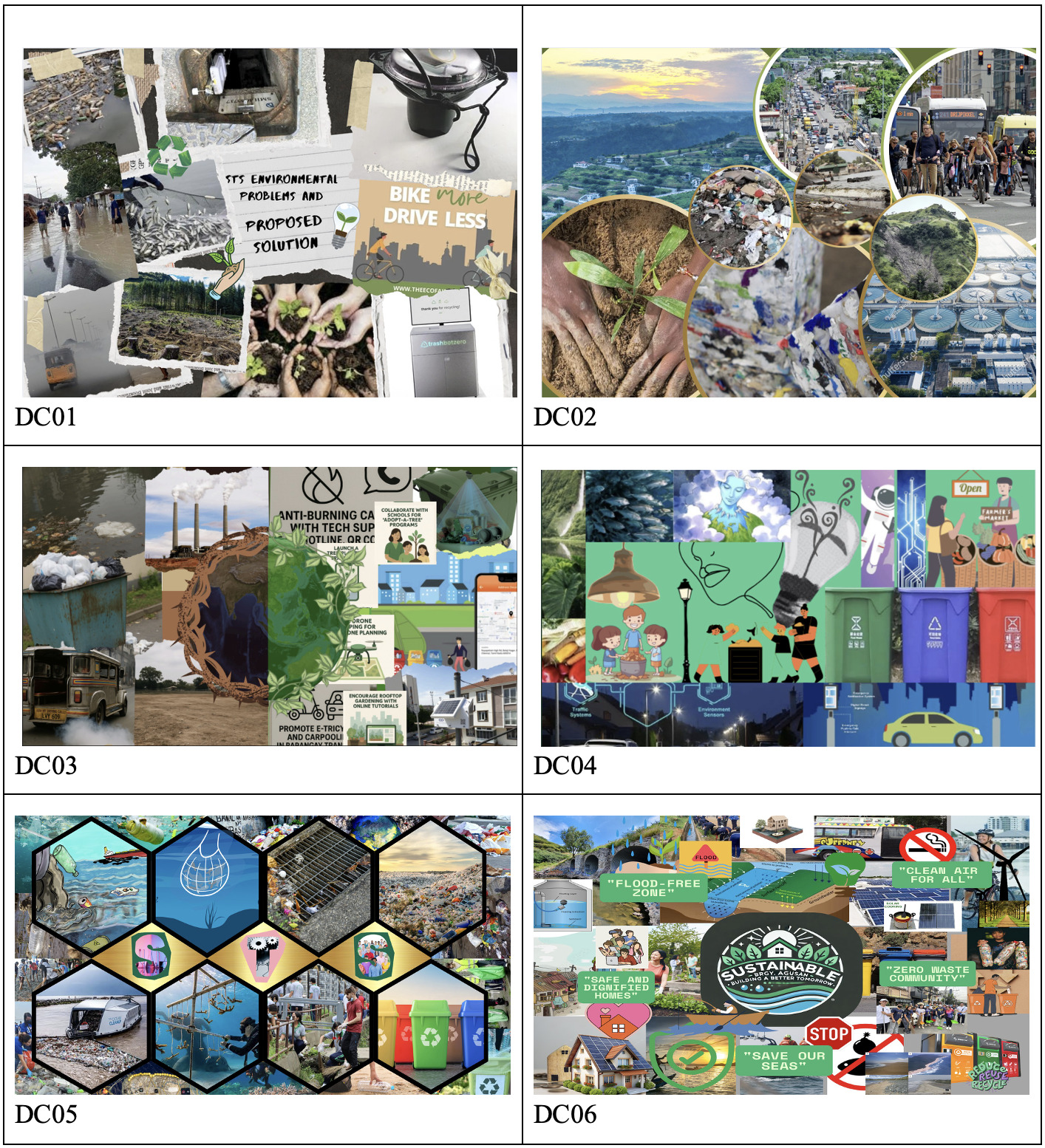
A central outcome of the project was the strengthening of the connection between global sustainability frameworks and local lived realities. Students were tasked with aligning their outputs to Sustainable Development Goal 11, yet their interpretations consistently reflected contextualized community experiences. Across the twelve collages, recurring themes included urban flooding, waste accumulation, transportation congestion, renewable energy integration, and coastal pollution. Representative examples of the digital collages are presented in Figure 1.
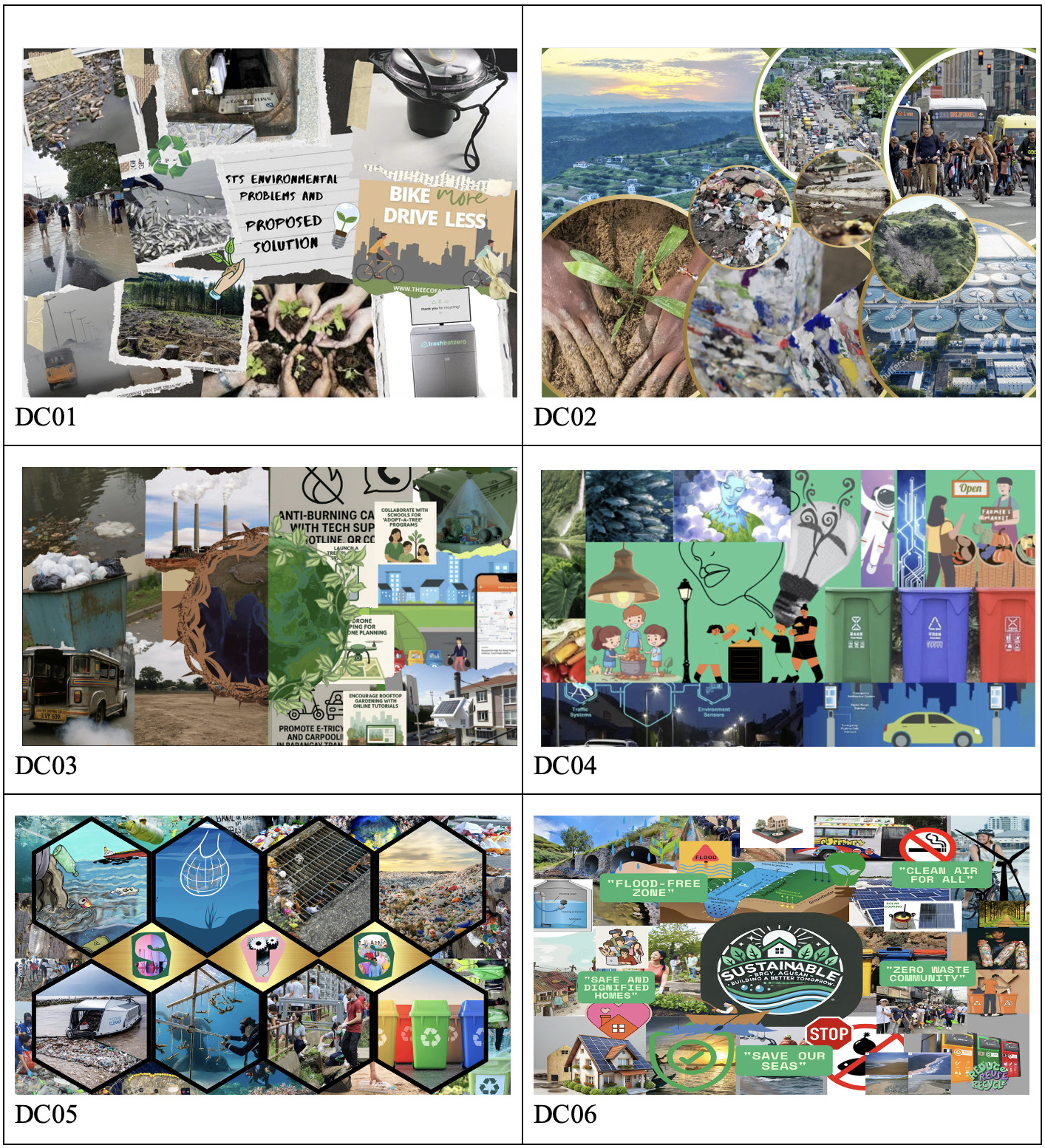
As illustrated, students embedded recognizable environmental conditions in their visual narratives. Rather than reproducing generic sustainability imagery, they incorporated visual cues that reflected their own surroundings. This contextual anchoring suggests that the visual storytelling process facilitated place-based learning and enhanced students’ ability to interpret sustainability as a lived and observable issue rather than an abstract policy framework.
Thematic Patterns in Visual Outputs
The semiotic patterns presented in Table 1 reveal several cross-cutting trends in how students represented sustainability. Across the collages, three dominant patterns emerged: (1) the use of visual contrast to depict present challenges and future possibilities, (2) the integration of symbolic elements such as mobility, waste, and energy to represent systemic issues, and (3) the inclusion of action-oriented imagery that suggests community-based solutions. These patterns indicate that students were not only identifying environmental problems but also structuring their visual narratives to communicate transformation and agency. Building on these observed patterns, the following discussion interprets how these visual strategies reflect deeper conceptual understanding and meaning-making processes.
In DC01, heavy traffic and greenery contrasted urban disorder and ecological aspiration, symbolizing the students’ desire for mobility and environmental wellness. DC03 juxtaposed pollution with clean energy and behavioral transformation using solar panels and overflowing garbage. These visual tactics show that students encoded value-laden perceptions of sustainability based on their surrounding environment, not just challenges. Photovoice and collage allow students to creatively express community concerns (Harrison, 2003). Collages were learning aids and instruments of civic participation in this environment.
The result also supports the multimodal theory that visuals can transmit complex and emotive meanings that words cannot (Dsouza & Panen, 2026). DC06 students designed and advocated for slogans like “Flood-Free Zone” and “Zero Waste Community”. Visual metaphors can synthesize global issues (SDG 11) with local realities, supporting multimodal learning theory, which states that meaning-making today is increasingly affected by visual, spatial, textual, and symbolic modalities (Seufert, 2026). Canva allowed students to collaborate on multimodal projects in real time, improving their conceptual and civic literacy. The collages’ semiotic patterns support the use of visual methods in sustainability education (Dondero, 2016), which demonstrates how visual tools can scaffold abstract notions such as equity, resilience, and innovation. Digital collage is both a creative tool and a rigorous, theory-aligned method for mapping young conceptions of sustainable urban futures (Cholimah & Tjiptasari, 2026; Harrison, 2003).
Emergence of Youth-Oriented Civic Proposals
Beyond visual representation, the project stimulated solution-oriented thinking. Several groups extended their collages to include proposed community-based initiatives such as drainage monitoring programs, zero-waste campaigns, solar energy demonstrations, and coastal clean-up drives. A summary of these proposals is presented in Table 2.
Although these initiatives were conceptual and not formally implemented, their inclusion demonstrates a shift from descriptive analysis to proactive engagement. Students positioned themselves not merely as observers of environmental problems but as potential contributors to community action. This outcome reflects the capacity of design-based activities to cultivate civic imagination and participatory awareness within sustainability education (Musannadah & Jannah, 2022; Parilah et al., 2025).
By grounding their visual narratives in their own socio-spatial contexts, students localized SDG 11’s global targets, such as improving urban resilience, reducing environmental impact, and enhancing access to safe and inclusive spaces (Dahms, 2026; Gunawan et al., 2026; Salsabila et al., 2026). In DC04, for instance, students integrated images of local markets and smart traffic systems, merging traditional economic practices with a vision for smart governance. This reflects the principle of “emic insight,” where the insider’s perspective provides culturally situated knowledge (Dondero, 2016; Wilson & Landon-Hays, 2016).
Such localization is essential in sustainability education, as emphasized by UNESCO (Dahms, 2026; Salsabila et al., 2026), which advocates for context-based learning to ensure relevance, authenticity, and community ownership. The students’ ability to relate to urban planning challenges through their own experiences affirms the principle that education for sustainable development (ESD) must begin with the learner’s environment. Rather than abstract lectures, the use of community visuals enabled students to explore critical urban problems such as informal drainage systems, hillside erosion, and solid waste overflow, not as passive observers but as active analysts (Dooly, 2026; Gunawan et al., 2026). Moreover, the collages revealed that youth are aware of the multi-scalar dimensions of urban challenges from neighborhood-specific (e.g., blocked drainage in DC05) to citywide (e.g., traffic and emissions in DC03). This suggests that students are already engaged in place-based critical thinking, which is described as “critical pedagogy of place,” where learners interrogate both environmental and sociopolitical dimensions of their surroundings (Dahms, 2026; İlhan et al., 2026; Pae et al., 2026).
Instructional Insights and Areas for Refinement
From an instructional perspective, the project provided several insights into integrating digital tools into higher education. Canva’s collaborative features supported equitable participation and reduced technical barriers, allowing students to focus on idea development. However, structured guidance was essential to maintain academic depth. Some groups initially emphasized aesthetic presentation over analytical substance, requiring instructor feedback to reinforce conceptual alignment with course objectives.
Implementation challenges included variations in digital proficiency and scheduling constraints for collaborative work outside class hours. Future iterations may benefit from allocating additional structured design time during class sessions and from incorporating milestone checkpoints to monitor conceptual progress. Despite these challenges, the project demonstrated that digital collage activities can function as structured pedagogical interventions that integrate creativity, contextual awareness, and analytical rigor.
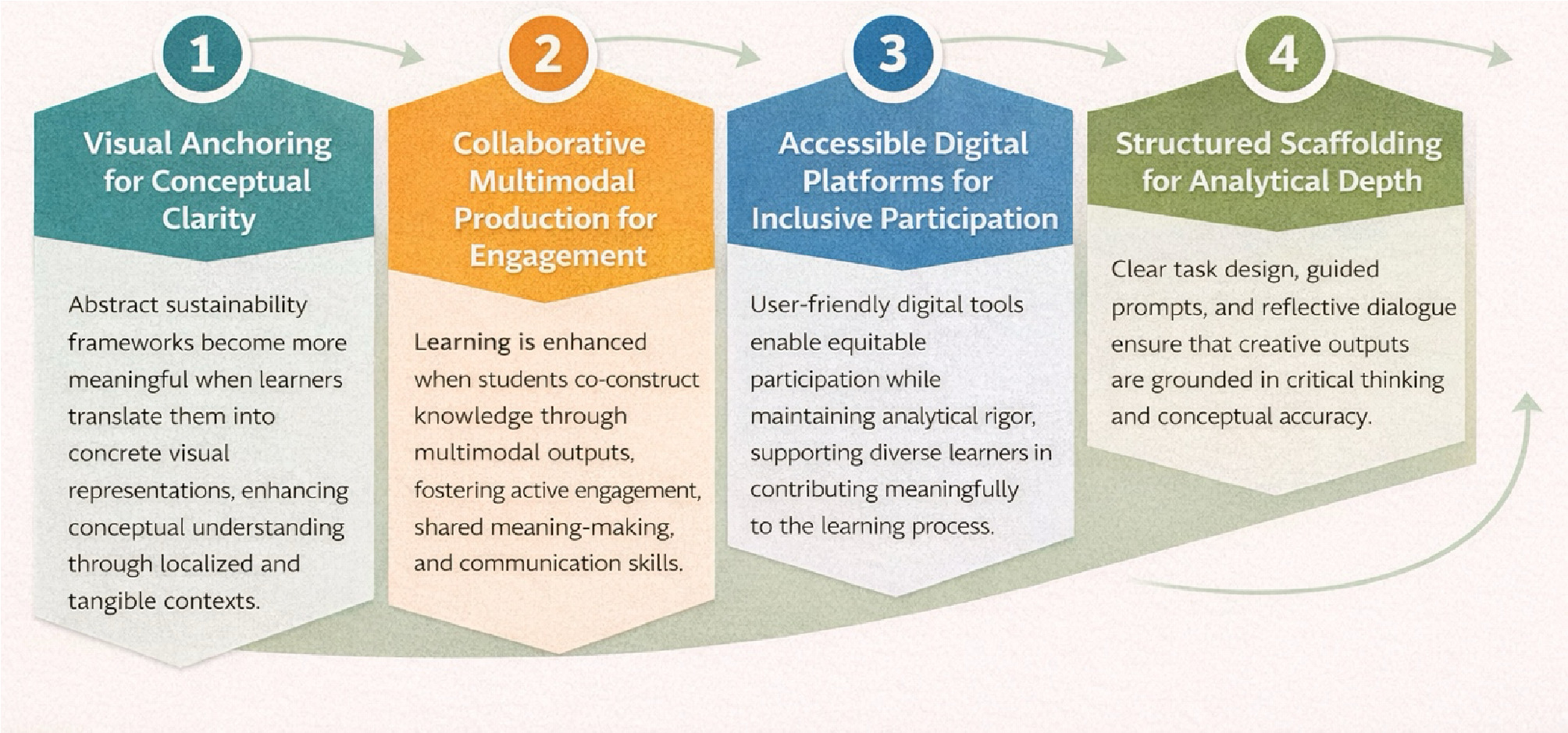
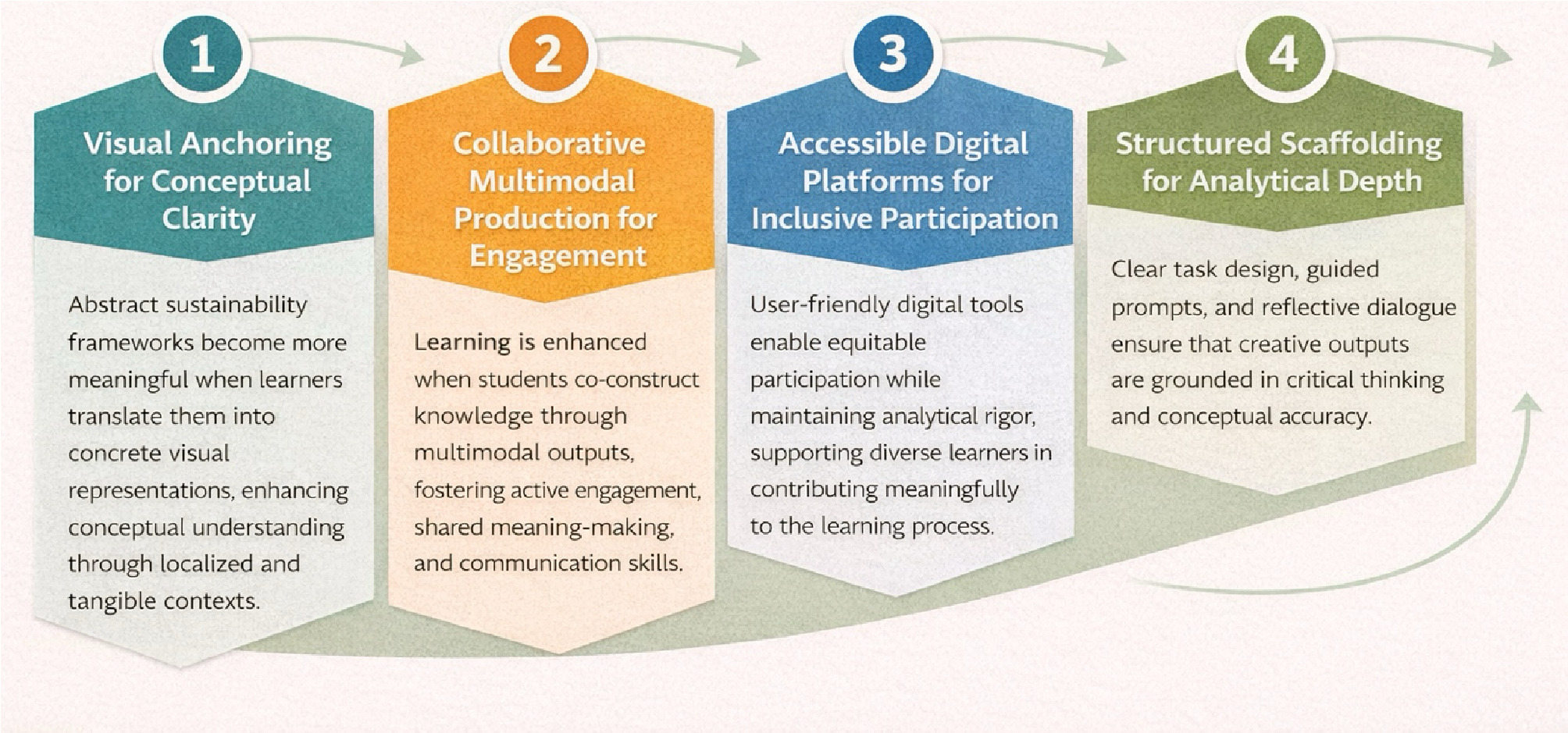
Derived from the implementation and analysis of the digital collage activity, the following instructional design principles are proposed: (1) Visual Anchoring for Conceptual Clarity: Abstract sustainability frameworks become more meaningful when learners translate them into concrete visual representations (Catubig et al., 2024; Safira et al., 2025); (2) Collaborative Multimodal Production for Engagement: Learning is enhanced when students co-construct knowledge through multimodal outputs (Alsuwaida, 2023; Mahmudah, 2023; Musannadah & Jannah, 2022); (3) Accessible Digital Platforms for Inclusive Participation: The use of user-friendly and widely accessible digital tools enables equitable participation while maintaining analytical rigor (Hasibuan et al., 2025; Parilah et al., 2025); and (4) Structured Scaffolding for Analytical Depth: Clear task design, guided prompts, and reflective dialogue are essential to ensure that creative outputs are grounded in critical thinking and conceptual accuracy (Lasaiba et al., 2025). The synthesized instructional design principles are summarized in Figure 2, representing a transferable framework for technology-enhanced sustainability education.
Conclusion
This study demonstrates that digital collage is not merely a creative classroom activity but a structured instructional design strategy that enables students to translate abstract sustainability concepts into contextually grounded and visually articulated understandings. More importantly, the findings suggest that visual storytelling functions as a cognitive bridge between global frameworks and local realities, allowing learners to synthesize complexity, express agency, and engage in meaning-making beyond traditional text-based outputs. This reinforces how visual anchoring enhances conceptual understanding by linking abstract frameworks to concrete representations, thereby making sustainability concepts more meaningful and accessible to students. The integration of multimodal design, collaboration, and place-based learning creates a learning environment where students do not simply understand sustainability; they interpret and reimagine it within their own communities, as collaborative multimodal production fosters deeper engagement and shared meaning-making among learners.
For instructional practice, this study highlights the value of designing learning tasks that combine visual production with analytical rigor and are supported by clear scaffolding and reflective dialogue. Moreover, the use of accessible digital platforms enables equitable participation while supporting analytical rigor, ensuring that all learners can contribute meaningfully regardless of technological constraints. In this way, the study reinforces the role of higher education in cultivating context-responsive and community-engaged forms of learning. The instructional model demonstrated in this study is adaptable across disciplines in which abstract concepts require contextualization, such as environmental education, the social sciences, and teacher education. Its reliance on accessible digital tools and structured scaffolding makes it particularly suitable for diverse higher education settings.
For research, the study highlights the strong potential of embedding qualitative visual inquiry within instructional design, arguing that it can serve as a powerful lens for understanding how students construct knowledge in technology-enhanced learning environments. By closely examining the images students select, the ways they arrange and layer visual elements, and the narratives they build around their collages, educators and researchers can gain deeper insight into students’ prior conceptions, emerging understandings, and the connections they make between personal experience and academic content. This approach suggests that learning is not only verbal or textual, but also profoundly visual, multimodal, and creative.
All in all, digital collage, as an instructional approach, positions students not only as learners of sustainability but also as active meaning-makers who help shape how sustainability is imagined and discussed. Through creating and revising their collages, students are invited to see themselves as visual thinkers who can organize complex information, explore tensions and contradictions in environmental issues, and experiment with different possible futures. In doing so, they also become emerging civic actors, capable of critically imagining and communicating sustainable futures to diverse audiences. The process of designing, sharing, and reflecting on digital collages encourages students to articulate their values, question dominant narratives, and envision more just and resilient societies, thereby linking classroom learning to broader social and ecological responsibilities.