Introduction
The rapid emergence of Generative Artificial Intelligence (GenAI) has created both opportunities and challenges in education. While GenAI can produce vast amounts of information and assist with complex tasks, it lacks the nuanced judgment and adaptability that human beings bring to problem-solving (Aljuaid, 2024; Carobene et al., 2023). This interplay between human skills and AI highlights the dual challenge of enhancing learning while preserving human judgment (Hao et al., 2024; Samala et al., 2024; Tang et al., 2024). Artificial intelligence (AI) and human thinking each bring distinct strengths, and successful collaboration relies on leveraging these strengths to address respective weaknesses (Lu et al., 2024; Muthmainnah et al., 2022; Rastogi et al., 2022).
There is a growing need to ensure that students remain critical decision-makers who use AI as a collaborative tool rather than a cognitive substitute. This paper proposes the AI-ARC framework as a student-facing model for developing agency and responsible AI use and as a design heuristic that can guide instructional designers in developing learning environments. It argues that responsibility in AI use is not a limit on agency but its strongest expression. Students act ethically not by avoiding AI, but by using it with judgment, reflection, and purpose. By guiding students to ask questions, reflect on AI outputs, and make original contributions, AI-ARC turns responsible AI use into an intentional, repeatable practice of agency in learning.
Several key terms require definition to support the conceptual argument. In the context of this paper, responsible AI use refers to the ethical, transparent, and accountable practice of working with AI tools in ways that preserve human judgment, originality, and integrity. It requires students to evaluate outputs, acknowledge limitations, and document how AI contributed to their work. This definition emphasizes that responsible use is not merely rule-following but a reflective practice that requires students to regulate how AI contributes to their thinking.
Because responsible AI use depends on students’ capacity to act deliberately and think critically, it naturally for defining student agency. Drawing on Bandura’s (1999) work, student agency refers to learners’ ability to make purposeful choices about their learning, including how, when, and why they use AI. Agency involves monitoring one’s thinking, questioning AI-generated ideas, and taking ownership of final products. These concepts form the foundation of the AI-ARC framework.
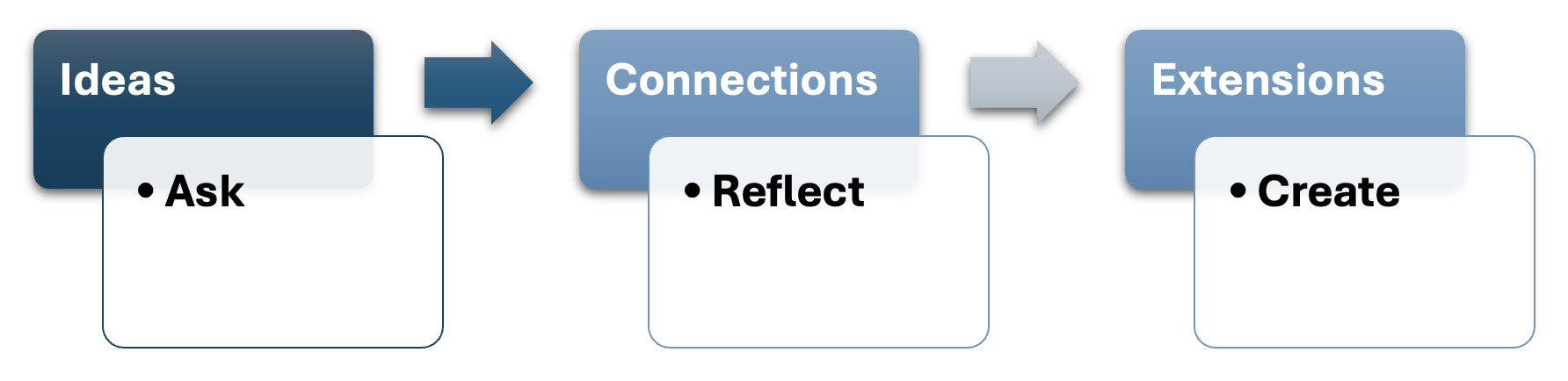
Because AI-ARC evolves from the AI-ICE framework, it is important to briefly clarify the original structure. The ICE model (Fostaty & Wilson, 2000) organizes cognitive development into three levels (Ideas, Connections, and Extensions) each representing a progression from generating information, to relating concepts, to applying and transforming knowledge. AI-ICE applied this sequence to students’ interactions with AI, and AI-ARC now reframes the same progression as student-facing actions known as Ask, Reflect, and Create.
Efficiency Trap
AI excels at processing vast amounts of data, identifying patterns, and generating outputs with remarkable speed and accuracy (Shien, 2024; Wan, 2024). Yet it lacks intuitive judgment, ethical reasoning, and the capacity to navigate ambiguity that characterize human thought (Aljuaid, 2024; Koos & Wachsmann, 2023). Humans, by contrast, make decisions in complex, uncertain environments by applying emotional intelligence, contextual awareness, and creativity. GenAI can extend these strengths by producing content, analyzing data, and offering rapid solutions across diverse domains (Carobene et al., 2023; Duhaylungsod & Chavez, 2023).
However, as AI efficiency increases, human critical thinking may decline when AI performs most of the cognitive work. Learners risk becoming passive recipients rather than active evaluators of information (Ahmad et al., 2023; Zhai et al., 2024). Zhai et al. (2024) found that users of GenAI often favor convenience over reflection. As this pattern becomes habitual, AI begins to take on much of the cognitive effort that would otherwise belong to the student, reducing opportunities for sustained analysis and critical thought. Consequently, environments where AI assumes too much of the cognitive load may limit students’ ability to engage deeply in problem-solving and decision-making (Duhaylungsod & Chavez, 2023; Koos & Wachsmann, 2023; Wachsmann, 2023; Zhu et al., 2024).
While GenAI can expand creativity and open new avenues for exploration, it also risks positioning students as passive consumers rather than active agents in learning. To counter this risk, educational design must intentionally integrate frameworks that center student agency, transforming AI collaboration into opportunities for inquiry, reflection, and co-design. If efficiency risks diminishing judgment, then fostering agency reintroduces the human capacity for reflection within AI collaboration.
From Efficiency to Agency
Rather than treating AI as a replacement for human capabilities, its greatest potential lies in fostering and improving human skills, particularly critical thinking (Peláez-Sánchez et al., 2024). Collaboration with GenAI can present the opportunity for individuals to evaluate and refine AI outputs, sharpening cognitive and decision-making skills (Bernabei et al., 2023; Essel et al., 2024; Hsiao et al., 2023; van den Berg & Du Plessis, 2023). The key is to create tasks and learning experiences where individuals must actively evaluate AI-generated outputs, challenge assumptions, and apply human judgment to improve the results (Grassini, 2023; Jia & Tu, 2024). The goal, therefore, is to leverage GenAI not merely for efficiency but to stimulate critical thinking through active critique and refinement of AI outputs. This iterative process enables students to maintain and even enhance their reasoning and decision-making skills while benefiting from AI’s strengths.
While AI’s computational capacity can streamline problem-solving, these efficiencies alone do not guarantee meaningful learning. Critical thinking emerges through student agency rather than existing in isolation. When students choose to question, verify, and extend AI outputs, they demonstrate the practical exercise of agency in learning. The question is how to design instruction so that the humans who use these systems remain thoughtful, independent decision-makers.
Cultivating Genuine Agency
Student agency emphasizes the role of students as active decision-makers in their educational endeavors rather than passive recipients of information. Agency reflects students’ capacity to make choices, act with purpose, and influence the direction of their own learning (Bandura, 1999). Agency in this context is not simply about activity but about purpose, where students must understand why they act, not just what they do. When students exercise agency, they demonstrate ownership over their work, engage critically with ideas, and connect classroom experiences to personal, professional, and societal contexts. Fostering agency leads to stronger motivation, deeper critical thinking, and more authentic engagement, as students view themselves not only as participants but as contributors to broader communities of practice (González-Howard et al., 2024; Mairitsch et al., 2023; Mameli et al., 2023; Stranford, 2024).
However, student agency is not automatic; it must be intentionally cultivated through purposeful design. González-Howard et al. (2024) caution against pseudo-agency, where students appear engaged but lack understanding of the epistemic purpose behind their actions. For instance, in a study by Gonzalez-Howard et al. (2024), students simply followed a checklist provided by the teacher without articulating why their chosen procedures mattered for answering the research question. Student participation met the surface requirements of inquiry but failed to reflect genuine decision-making or conceptual understanding. Similarly, in AI collaboration, pseudo-agency occurs when students use tools uncritically, employing AI outputs without questioning validity. To counter this, educators must design learning experiences that make the why of AI use transparent and not substitute activity for understanding.
Relational Dimensions of Agency
Agency is not solely an individual trait but a socially and technologically mediated process shaped by relationships, contexts, and tools. Gupta et al. (2024) and Mairitsch et al. (2023) found that agency develops through the interplay of intrapersonal, behavioral, and contextual dimensions such as motivation, reflection, and social support. Likewise, Mameli et al. (2023) demonstrated that educator response and classroom dynamics can either empower or suppress student agency. Classrooms that promote trust, collaboration, and equitable participation create the psychological safety necessary for students to take ownership of their learning and critically engage with AI. Agency also evolves through interactions with technology, as Stenalt (2021) advised that digital tools actively shape human action and perception. For example, AI tools that auto-suggest text can subtly steer students toward accepting surface-level answers rather than exploring alternative solutions, thereby influencing the scope of their decision-making.
Within AI-enabled learning, students must navigate their relationship with AI critically and ethically, learning when to rely on it, when to question it, and when to diverge from its outputs. Adhikari and Pandey (2025) highlighted that integrating AI can profoundly strengthen student agency when educators create conditions that allow learners to actively guide and reflect on their use of such tools. Together, the dimensions of intentional design, social context, and relational awareness position agency as a dynamic and teachable construct. Recognizing agency as an instructional outcome, rather than an innate trait, has direct implications for AI-integrated learning. Students’ engagement with AI reflects varying degrees of reflection, dependence, and critical control, revealing opportunities for intentional design interventions.
Challenges and Opportunities
Without deliberate scaffolding, AI can shift key cognitive processes away from learners, reducing opportunities for practice. In a writing-intensive course, for example, students might be encouraged to use a generative AI tool to “improve” their essays but receive little guidance on how or why to use it. Many begin uploading full drafts and accepting the AI’s revisions wholesale rather than revising their own work. Over time, students rely on AI tools to identify errors, reorganize arguments, and even generate thesis statements. Instead of planning, monitoring, and evaluating their own learning, the core components of self-regulated learning, they defer these processes to the AI system. As a result, students’ metacognitive awareness and confidence in independent problem-solving decline, even though the final products may appear more polished.
This example reflects Darvishi et al.‘s (2024) warning that when AI is introduced without pedagogical scaffolding, it can replace rather than reinforce learners’ self-regulatory processes. To prevent this, educators must design learning experiences that position AI as a partner in planning, monitoring, and reflection. Such design choices ensure that learners, and not the system, retain cognitive control.
Other studies demonstrate that learners can exercise agency when learning environments are designed to support them. Engeness et al. (2025) found students engaged in metacognitive self-regulation and deep reflection by comparing AI-generated explanations with course materials, questioning inaccuracies, and revising outputs in their own words, while Radtke and Rummel (2025) also found that when students revised texts identified as AI-generated, the activity could be both productive and efficient by yielding learning benefits comparable to traditional peer review. Yet challenges persist, including the risks of overreliance (Buçinca et al., 2021; Kim et al., 2025; Zhai et al., 2024), static and limited use patterns without guidance (Lee et al., 2025), and the inadequacy of traditional assessments in measuring cognitive agency (Herman & Lara, 2025).
In parallel, scholars emphasize the importance of cultivating broader literacies and competencies for an AI-enabled future. Muthukrishnan et al. (2024) identify AI literacy including intrinsic motivation and ethical learning, as key predictors of responsible use, while Nieminen et al. (2024) argue for epistemic agency to link assessment, knowledge, and society. Frameworks such as the PAIRR model (Sperber et al., 2025) and Generativism (Uanachain & Aouad, 2025) propose new pedagogical designs to integrate AI more meaningfully, and Xia et al. (2025) provide a psychometric tool (SLA-GAI) to measure student agency in AI contexts.
Together, these works highlight a common conclusion that fostering agency, reflection, and ethical judgment is essential to ensure that students engage with AI as co-designers rather than passive consumers. Despite this progress, many frameworks are educator-centric or overly complex, limiting student uptake and scalability. What is missing is a simple, student-facing scaffold that instructional designers can use that supports students’ capacity to guide responsible, self-directed interaction with AI.
AI-ICE Model, Student Agency, and Responsible Use
The AI-ICE model was originally developed as an evaluative lens to examine how students engaged with GenAI in academic contexts (Wood & Moss, 2024). The original AI-ICE framework was adapted from the established ICE model (Fostaty & Wilson, 2000), which assesses cognitive development through the stages of Ideas, Connections, and Extensions. The AI-ICE framework further integrated the three paradigms of AI in education outlined by Ouyang and Jiao (2021) to provide a structured approach for categorizing levels of student engagement when interacting with AI tools.
At the Ideas stage, students relied on AI primarily to generate content, often in exploratory or descriptive ways, reflecting surface-level engagement. The Connections stage represented a deeper level of interaction, in which students critically compared AI outputs with course concepts, ethical considerations, and personal insights, demonstrating analytical thinking. Finally, the Extensions stage captured the most advanced level of engagement, in which students transformed or built upon AI-assisted outputs to create original, integrative, and ethically grounded contributions.
Used in this way, the AI-ICE model highlighted both the potential and the limits of GenAI in education, showing that while students were comfortable generating ideas with AI, fewer reached the higher-order levels of critical evaluation and creative extension (Wood & Moss, 2024). The evaluative function made AI-ICE a valuable research tool for assessing how learners navigated novelty, ethics, and agency when students incorporated AI into their work. The framework not only revealed how students engaged with AI but also illuminated the underlying interplay between ethical responsibility and agency in those interactions. Recognizing this connection highlights a crucial shift to fostering responsible AI use not solely as a matter of compliance but as a reflection of students’ capacity to act with intention, judgment, and integrity.
Although AI-ICE was originally developed as an evaluative tool, its insights extend well beyond assessment. The framework revealed that ethical engagement and personal agency are inseparable in effective AI use. Responsible use and student agency are interdependent concepts that inform how students engage meaningfully with GenAI. Student agency provides the autonomy to make purposeful decisions about when and how to use AI, while responsible use ensures those decisions are guided by ethical awareness, transparency, and accountability. Together, they foster a learning environment where students critically evaluate AI outputs, reflect on their intentions, and take ownership of the knowledge they produce. In this sense, responsible AI use becomes the ethical expression of agency as an active, reflective practice that transforms students from passive users of GenAI into intentional, self-directed collaborators in their own learning.
Shifting AI-ICE to AI-ARC Framework
While the original model served as a framework for researchers to evaluate levels of engagement, it also revealed an opportunity for students to benefit from using the same structure to guide their own practices with AI. By shifting AI-ICE into the hands of students, the framework becomes more than a diagnostic lens; it transforms into a roadmap for agency, showing students how to move beyond simple idea generation toward critical evaluation and creative extension. AI-ICE addresses ethical challenges by giving students clear stages through which they can practice discernment, integrate disciplinary knowledge, and develop originality in their work.
With the change in purpose from a research evaluation tool to a student-facing framework, the framework evolves from AI-ICE to AI-ARC (Ask, Reflect, Create). While the foundational structure remains the same, this shift in name and emphasis better captures the active, learner-driven orientation of the adapted framework. Ask replaces Ideas, emphasizing curiosity, questioning, and intentional interaction with AI to surface possibilities rather than passively receiving outputs. Reflect replaces Connections, centering ethical awareness and critical judgment as students evaluate AI-generated content in relation to disciplinary knowledge, context, and personal intent. Create replaces Extensions, representing the synthesis stage where learners transform AI-supported ideas into original, meaningful, and ethically grounded work. Figure 1 illustrates the conceptual shift from the original AI-ICE framework.
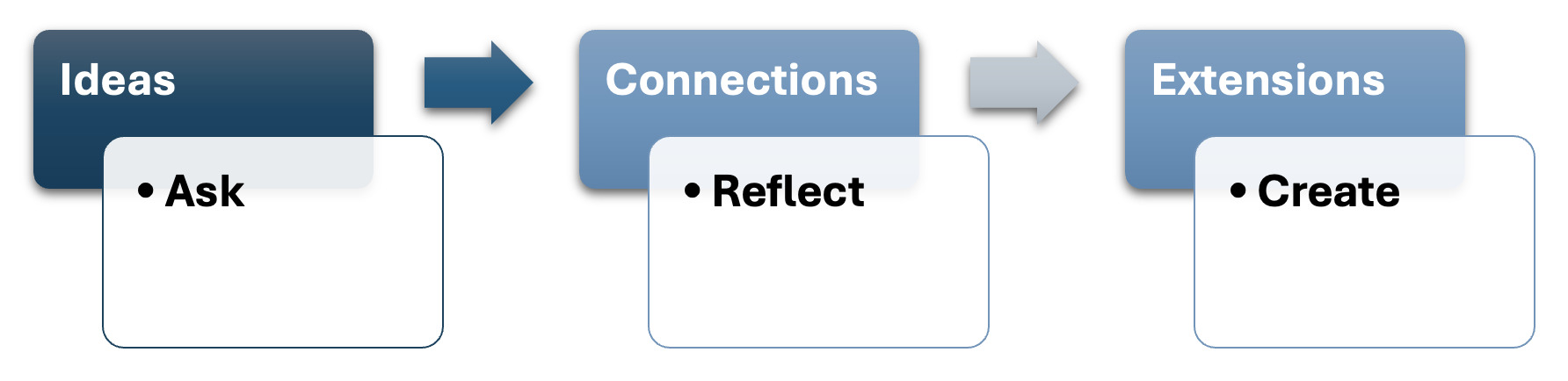
To support responsible, active use of GenAI, the AI-ARC framework functions as a practical guide. The framework emphasizes progression from asking purposeful questions to reflecting critically on AI outputs and their ethical implications to creating original, meaningful contributions. At each stage, student agency is central. Table 1 outlines the stages of AI-ARC with the focus, the role of student agency, and example questions students might use to guide engagement.
Table 2 suggests how AI-ARC can be applied across diverse disciplines. Each example demonstrates how the Ask, Reflect, Create progression can guide students from initial exploration with AI to deeper critical engagement and finally to original work.
The new name captures the framework’s purpose to lead students through an ongoing arc of inquiry, reflection, and creation that fosters agency, integrity, and critical thinking in AI-based learning. This arc represents both a process and a trajectory that begins with curiosity, deepens through ethical reflection, and culminates in creative action. In this sense, learning with AI becomes a dynamic journey of growth rather than a linear task of production. Consequently, the student-facing AI-ARC framework provides a means to cultivate responsible habits of mind, help students retain ownership, authorship, and critical voice when collaborating with AI. For example, in the Ask stage, students might use AI to brainstorm multiple perspectives on a problem rather than accept the first output. During Reflect, students evaluate those responses against disciplinary criteria and ethical considerations. Finally, in Create, students transform or extend AI-generated material into original work that demonstrates personal insight and professional integrity.
Framing students as co-designers of knowledge reflects a pedagogical shift that emphasizes agency, collaboration, and responsibility in the age of GenAI. Rather than positioning AI as a source of ready-made answers, the AI-ARC framework encourages students to use it as a partner in the construction of meaning. In this framing, students are not passive recipients of machine-generated content but active participants who guide, critique, and transform AI outputs into knowledge that is personally and academically meaningful. By moving through the stages of Ask, Reflect, and Create, students practice critical engagement and ethical reasoning while also taking ownership of the learning process. Ultimately, framing students as co-designers reaffirms the centrality of human judgment, creativity, and values in integrating of AI into educational and professional practice.
Implementation in Educational Contexts
The AI-ARC framework brings together the key dimensions of critical thinking, student agency, and responsible AI use by translating complex theoretical and ethical considerations into a practical guide for students. It addresses the cognitive challenge of maintaining critical thinking in AI-mediated environments by structuring engagement through three progressive stages that require students to question, evaluate, and create rather than merely consume AI outputs. It supports student agency by positioning students as decision-makers who choose how to use AI, reflect on its relevance, and take ownership of learning products. In doing so, AI-ARC operationalizes responsible AI use, ensuring that autonomy is exercised ethically, transparently, and with accountability.
The framework also aligns with research emphasizing self-regulated learning and metacognition, as students move intentionally from exploration to analysis to synthesis (Bosch & Kruger, 2024; Darvishi et al., 2024). Furthermore, AI-ARC responds to the broader pedagogical gap identified in the literature by offering a simple, student-facing alternative to educator-centric or overly complex models. Ultimately, the framework has the potential to unite efficiency with ethics, technology with human judgment, and automation with agency, offering a potential pathway for students to become reflective, ethical, and creative co-designers of knowledge in the age of GenAI.
Classroom Strategies
Classroom strategies for embedding the AI-ARC framework can take multiple forms, including assignments that explicitly guide students through the stages of Ask, Reflect, and Create. For example, in a first-year writing course, educators might ask students to begin the Ask stage by using AI to generate several possible thesis statements about the ethical implications of social media. In the Reflect stage, students analyze the AI-generated ideas against course readings on digital ethics, evaluating which align with established arguments and which reveal bias or oversimplification. Finally, in the Create stage, students compose an original work that integrates their refined thesis and critical perspective, explicitly citing how AI informed and changed their thinking. Reflection tasks are particularly effective, prompting students to document how they used AI, what choices they made, and how they ensured their own authorship and integrity in the final product. Peer collaboration can also enhance this reflective process by having students compare AI-assisted outputs, critique them together, and discuss how each person extended the work in unique ways, reinforcing the importance of judgment and originality.
For educators and instructional designers, the key is to scaffold AI use without undermining student autonomy. This means providing clear structures such as step-by-step prompts, a checklist of ethical concepts to consider, or reflection journals while still allowing students the freedom to decide how deeply to engage at each stage of the framework. Scaffolding in this way helps students build confidence and critical skills without slipping into overreliance. Finally, integrating AI-ARC with academic integrity policies and responsible use guidelines ensures alignment with institutional values. The alignment helps normalize responsible AI use as part of academic integrity rather than a separate compliance burden. When students see that responsible AI engagement is expected and supported, they are better prepared to navigate ethical complexities in both academic and professional contexts.
AI-ARC for Instructional Designers
While the AI-ARC framework was developed to support responsible AI use among learners in K–12 and higher education, it also offers a practical tool for instructional designers seeking to integrate GenAI into learning experiences in purposeful, ethical, and learner-centered ways. As a design heuristic, AI-ARC helps instructional designers structure activities and assessments that foster increasingly complex cognitive and ethical engagement with AI, ensuring that AI integration enhances rather than replaces human judgment and creativity. By using AI-ARC as both a planning lens and a reflective scaffold, designers can create experiences that preserve learner agency while harnessing AI’s potential to support inquiry, analysis, and original creation.
At the Ask stage, instructional designers can encourage exploratory learning by prompting students to generate questions, gather ideas, and surface possibilities with AI. This stage supports curiosity and discovery rather than correctness, and it can be facilitated through open-ended prompts, scenario-based inquiry, or brainstorming activities. The Reflect stage integrates critical and ethical reasoning by asking students to analyze AI-generated outputs, compare them to disciplinary standards, and consider issues such as bias, accuracy, and authorship. Designers can embed this reflection through structured journals, guided discussions, or formative checkpoints that invite students to evaluate the role and quality of AI contributions.
Finally, the Create stage emphasizes synthesis and originality, guiding students to move beyond AI-generated content to produce meaningful, authentic work. Designers can support this process through project-based assessments, case analyses, or creative tasks that require students to apply human insight, creativity, and ethical accountability. In this manner, AI-ARC acts as a bridge from theory to practice by providing a structured yet flexible model for designing learning experiences that cultivate responsibility, agency, and critical engagement with AI across diverse instructional contexts.
Instructional designers can also use AI-ARC during the design phase to align learning outcomes, activities, and assessments with responsible AI integration. For instance, during analysis and design, instructional designers can map course objectives to each ARC stage to determine where AI should support inquiry, where human judgment must remain central, and where students are expected to synthesize ideas independently. During development, AI-ARC can guide the creation of prompts, reflection checkpoints, and assignment scaffolds that encourage deeper engagement. Finally, during evaluation, instructional designers can use the ARC stages as criteria for reviewing whether a course supports ethical AI use and preserves student authorship. In these ways, the AI-ARC framework becomes a design heuristic that supports responsible, thoughtful AI integration.
Impact and Influence
The AI-ARC framework is designed to directly support the shift from students as consumers of GenAI outputs to active co-designers of knowledge. Rather than passively accepting AI-generated responses, students move through a structured progression emphasizing curiosity, critical engagement, and originality. At the Ask stage, they surface possibilities; at the Reflect stage, they analyze and evaluate; and at the Create stage, they assume authorship by transforming outputs into meaningful, creative contributions. This structured process reinforces student agency and ensures that AI serves as a collaborative partner rather than a substitute for human thought.
Equally important, AI-ARC provides the opportunity to foster ethical practice by embedding reflection and responsibility at every stage. Students learn to identify bias, question assumptions, and uphold standards of integrity when integrating AI into their work. By explicitly connecting AI use to ethical reasoning, the framework helps prepare students for professional contexts where accountability, transparency, and originality are non-negotiable. In this way, AI-ARC addresses immediate academic concerns and cultivates transferable habits of mind critical for the workplace.
Conclusion
As AI becomes more deeply embedded in education, the challenge is not simply to use it efficiently but to ensure that its use strengthens rather than supplants human judgment, ethical reasoning, and critical thinking. This paper has argued that responsible AI use represents the most authentic expression of student agency, wherein learners make ethical, purposeful choices about how to engage with technology. The AI-ARC framework reframes this relationship by guiding students through a continual cycle of inquiry, reflection, and creation. In doing so, it transforms responsible use from a compliance-driven expectation into a deliberate cognitive and ethical practice.
Beyond individual classroom use, AI-ARC also provides a valuable resource for instructional designers. When applied during the design phase, the framework offers a structured lens for determining how and why learners will engage with AI, helping designers create assignments and assessments that promote both cognitive depth and ethical awareness. By embedding opportunities for students to ask questions of AI, reflect critically on its outputs, and create original products that extend beyond AI-generated material, instructional designers can intentionally cultivate agency and authorship. In this sense, AI-ARC becomes not only a guide for students but a planning tool that aligns instructional choices with the broader goals of responsible and learner-centered AI integration.
Taken together, AI-ARC offers a practical structure for designing learning environments that center critical thinking, integrity, and authorship across educational roles. By supporting both instructors and instructional designers, the framework can provide for responsible AI use that is taught, modeled, and reinforced through purposeful design. Ultimately, AI-ARC suggests that intentional AI collaboration can deepen human creativity and ethical reasoning and position students as thoughtful co-creators rather than passive consumers in AI-enabled learning.